Last updated: 29 Sep 2026
How to Stop French Bulldogs from Chewing Everything
If you’re wondering how to stop French Bulldogs from chewing everything, you’re probably dealing with more than a missing shoe or a damaged piece of furniture. French Bulldog puppies often chew while teething and exploring their surroundings, while older Frenchies may chew because they’re bored, stressed, under-stimulated, or have simply developed a habit.
There is a moment almost every French Bulldog owner knows. You leave the room for a few minutes, come back, and somehow your Frenchie has found a shoe, a piece of cardboard, the TV remote, or the corner of the couch.
And they look completely innocent.
The goal isn’t to stop your Frenchie from chewing altogether. Chewing is a normal dog behavior. Instead, you want to teach your dog what is appropriate to chew, prevent access to things they shouldn’t have, and make the right choices more rewarding.
Once you understand why your Frenchie is chewing, it becomes much easier to change the behavior.
Why Does My French Bulldog Chew Everything?
Before trying to stop the behavior, pay attention to when it happens.
Does your Frenchie chew when you’re busy? When they haven’t had anything to do for a while? When you’re getting ready to leave? Only when they’re alone?
Those details matter.
Here are some of the most common reasons French Bulldogs chew household objects.
Teething
Puppies explore the world with their mouths, and teething can make the urge to chew even stronger.
If you have a young Frenchie, you may notice them chewing table legs, shoes, blankets, toys, and anything else they can reach.
This doesn’t mean your puppy is being “bad.” They need to learn which things are acceptable to chew.
🦴 For French Bulldog Puppies
For puppies who are going through the teething stage, a puppy-appropriate chew toy can provide a safer outlet for chewing and help redirect them away from furniture and household items.
→ See the KONG Puppy Teething Toy on Amazon
Boredom
French Bulldogs are companion dogs, but being a companion breed doesn’t mean they can entertain themselves all day.
A Frenchie who has little mental stimulation may find their own entertainment.
Unfortunately, your new sofa may look much more interesting to your dog than the chew toy sitting beside it.
Too Much Energy
Frenchies generally don’t need the same kind of intense exercise as high-energy working breeds. However, they still need regular activity and mental stimulation.
A short walk followed by hours of doing nothing may not be enough for some dogs.
At the same time, you shouldn’t try to solve chewing by simply exercising a Frenchie harder and harder. Their short-nosed anatomy can make breathing and heat regulation more difficult, particularly during hot or humid weather.
A better approach is to combine appropriate exercise with sniffing, training, play, and food-based enrichment.
Anxiety or Trouble Being Alone
This is one of the most important things to notice.
If your Frenchie behaves perfectly while you’re home but starts chewing doors, furniture, shoes, or other objects soon after you leave, don’t automatically assume they’re being stubborn.
Some dogs develop separation-related problems and may become distressed when left alone.
A camera can help you understand what’s actually happening. You may discover that your dog isn’t simply looking for something to chew—they may be pacing, barking, whining, scratching at doors, or struggling to settle.
Attention
Sometimes chewing becomes a way to start an interaction.
Your dog grabs a shoe.
You chase them.
They run away.
You chase again.
From your point of view, you’re trying to get the shoe back. From your Frenchie’s point of view, you may have just started a very exciting game.
That’s why calmly teaching “drop it” and redirecting your dog is usually more useful than chasing them around the house.
Habit
Dogs repeat behaviors that work for them.
If chewing the corner of the rug has been fun for weeks, your Frenchie has had plenty of practice doing it.
The longer the habit continues, the more important prevention becomes.
Start by Finding the Pattern
Before changing your entire routine, watch your Frenchie for a few days.
Write down:
- What they chew
- Where they chew it
- What time it happens
- Whether you’re home or away
- What happened immediately before the chewing
- How you responded
- What your dog did afterward
You may notice a pattern.
For example, a puppy may chew more in the evening when they are tired and restless. An adult dog may only destroy things when left alone. Another Frenchie may simply have learned that grabbing laundry gets everyone’s attention.
Once you know the pattern, your solution becomes much clearer.
1. Make Your Home Easier for Your Frenchie to Get Right
Training is important, but management matters just as much.
If your Frenchie can reach something tempting every few minutes, you’re giving them hundreds of opportunities to make the wrong choice.
Put tempting items away.
That includes:
- Shoes and slippers
- Socks
- Children’s toys
- Remote controls
- Plastic packaging
- Trash
- Food wrappers
- Small household objects
- Chargers
- Electrical cords
- Bags and purses
Keep bedroom and bathroom doors closed if necessary.
Baby gates can also be useful when you need to restrict access to certain areas.
This isn’t about keeping your dog locked away from the house forever. It’s about preventing unwanted chewing while your dog is still learning.
Think of it as setting your Frenchie up to succeed.
2. Give Your Frenchie Something Worth Chewing
You can’t realistically expect a dog to stop enjoying chewing.
Instead, teach them where chewing is welcome.
Offer several appropriate chew toys that are suitable for your dog’s age, size, and chewing style.
You might use:
- Durable rubber toys
- Food-stuffable toys
- Puppy teething toys
- Interactive food toys
- Other veterinarian-recommended chew products
Not every chew product is appropriate for every dog.
A strong chewer may destroy a toy that another dog uses safely for months. Check toys regularly and remove them if they are breaking apart or producing pieces your dog could swallow.
The best chew toy is not necessarily the hardest one. It is one that is appropriate for your individual dog and can be used safely.
Recommended Chew Toy
A durable, stuffable rubber toy can give your Frenchie something appropriate to chew instead of shoes, furniture, or other household items.
→ Check the KONG Classic on Amazon
3. Rotate the Toys
Here’s a simple trick that many owners overlook.
You don’t have to leave every toy on the floor all day.
Keep a small selection available and rotate the others.
After a few days, bring out a toy your Frenchie hasn’t seen recently.
It can suddenly seem much more interesting.
You can also reserve certain food toys for times when your dog needs something productive to do, such as when you’re working from home or preparing dinner.
4. Give Your Frenchie More Mental Stimulation
Sometimes the answer isn’t a longer walk.
It’s something that makes your dog think.
French Bulldogs can benefit from simple activities such as:
Sniffing
Let your dog spend time sniffing during walks rather than rushing through the entire walk.
You can also hide pieces of their regular food around a safe room and let them search for it.
Food puzzles
Food-dispensing toys can turn part of a meal into an activity.
Start with something easy. If the puzzle is too difficult, your dog may simply give up.
Short training sessions
Practice one skill for a few minutes:
- Leave it
- Drop it
- Stay
- Place
- Come
- Sit
You don’t need a long formal training session.
A few minutes here and there can make a difference.
Simple games
Hide a favorite toy and encourage your Frenchie to find it.
Play gentle indoor games when outdoor conditions aren’t suitable.
The idea is simple: give your dog something better to think about than your furniture.
🧠 Add More Mental Stimulation
Nina Ottosson Interactive Dog Puzzle
Food puzzles can give your Frenchie something productive to focus on, especially when boredom is contributing to unwanted chewing.
→ Check the puzzle toy on Amazon
5. Exercise Your Frenchie, But Don’t Overdo It
Exercise can help with boredom, but French Bulldogs require some common sense when it comes to physical activity.
Because Frenchies are brachycephalic (short-nosed), they can have difficulty breathing and cooling themselves efficiently. Hot and humid weather can be particularly dangerous.
This matters for many U.S. owners during summer.
A walk that feels comfortable to you may be too much for your Frenchie on a hot afternoon.
Instead of focusing on exhausting your dog, aim for a balanced routine that may include:
- Short walks
- Sniffing
- Gentle play
- Training
- Indoor enrichment
- Food puzzles
On very hot days, consider doing more activities indoors and taking walks during cooler parts of the day.
If your Frenchie is struggling to breathe, excessively panting, becoming weak, or showing other signs of overheating, stop the activity and seek veterinary advice.
Your dog’s age, health, weight, and fitness level also matter, so exercise needs are not identical for every Frenchie.
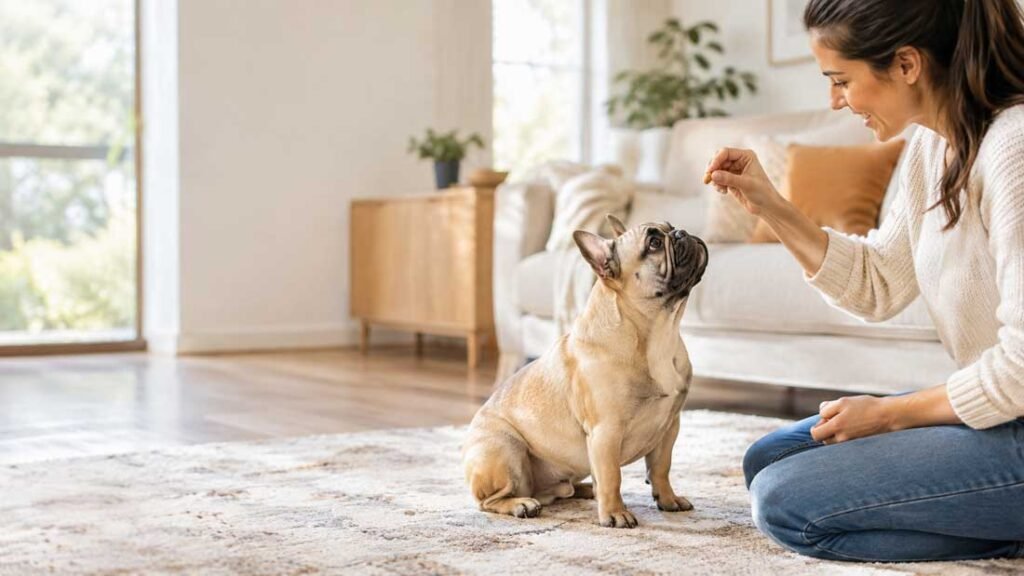
6. Teach “Leave It”
“Leave it” can be one of the most useful commands for a dog who likes to investigate everything.
Start somewhere quiet.
Hold a treat in your closed hand.
Your Frenchie will probably sniff or paw at it.
Wait.
As soon as they stop trying to get the treat and move their attention away, reward them with another treat.
Repeat this several times.
Once your dog understands the game, gradually introduce the words “leave it.”
Later, practice with safe objects on the floor.
Don’t start by putting your dog’s favorite stolen item in front of them and expecting perfect obedience.
Build the skill slowly.
7. Teach “Drop It” Without Starting a Tug-of-War
“Drop it” is especially useful when your Frenchie already has something in their mouth.
If they grab a sock, don’t automatically chase them.
Instead, offer a treat or another appropriate toy.
When they release the sock, reward them.
Then give the dog something they are allowed to have.
Practice this regularly when nothing important is at stake.
That way, “drop it” becomes a familiar behavior rather than something you suddenly demand when your dog has stolen something valuable.
What if the object is dangerous?
If your dog has grabbed something dangerous, don’t turn the situation into a chase game.
Use your trained cue if possible and calmly exchange the object.
If your dog has swallowed something potentially dangerous, contact your veterinarian promptly for advice.
8. Reward Your Frenchie for Making Good Choices
This is where many owners accidentally miss a training opportunity.
Imagine your Frenchie walks past your shoe, picks up their own chew toy, and lies down with it.
That’s exactly what you want.
Notice it.
Say something like:
“Good!”
Give gentle praise or a small reward and let your dog continue chewing.
You don’t have to make a huge celebration every time.
You’re simply showing your Frenchie:
“Yes, that’s the choice I like.”
Dogs learn through repeated consequences. If appropriate chewing consistently leads to good things, it becomes easier for your dog to choose it.
9. Don’t Chase Your Frenchie for a Stolen Shoe
This deserves its own section because it’s such a common situation.
Your Frenchie grabs your favorite sneaker.
You stand up.
They run.
You follow.
They run faster.
Now you’re playing chase.
Instead, stay calm and use “drop it” if your dog has learned the cue.
You can also offer a suitable toy or treat as an exchange.
Once your dog releases the shoe, quietly put it away.
No dramatic reaction is necessary.
The less exciting the stealing game becomes, the less reason your dog has to repeat it for entertainment.
10. Don’t Punish Your Frenchie After You Find the Damage
You walk into the living room and find a destroyed cushion.
Your first reaction may be frustration. That’s completely understandable.
But yelling at your dog after the fact won’t teach them what they should have done instead.
Your Frenchie may react to your angry body language or voice, but they aren’t going to understand a lecture about something they chewed earlier.
Instead, ask yourself:
How did my dog get access to this?
Then fix the situation.
Move the object.
Block the room.
Increase supervision.
Provide an appropriate alternative.
Look at whether your dog needs more enrichment.
Training works much better when you’re teaching the behavior you want rather than simply punishing the behavior you don’t.
11. If Your Frenchie Chews Only When You’re Gone, Pay Attention
This pattern is worth taking seriously.
Let’s say your Frenchie is relaxed while you’re sitting on the couch.
You leave for work.
Within 15 minutes, the dog starts chewing the door, scratching near the exit, barking, or destroying things.
That is different from a puppy casually chewing a toy while you’re in another room.
Try using a pet camera to see what happens after you leave.
Look for:
- Pacing
- Repeated barking or whining
- Scratching at doors
- Attempts to escape
- Heavy panting
- Inability to settle
- Destruction that starts soon after departure
These behaviors can occur with separation-related distress.
If this sounds like your Frenchie, don’t assume that buying five more chew toys will solve the problem.
Talk with your veterinarian or a qualified behavior professional about the pattern you’re seeing.
12. Make Alone Time Easier
If your Frenchie is comfortable being alone, give them something appropriate to do before you leave.
For example:
- A safe food-stuffable toy
- A puzzle feeder
- A familiar chew toy
- A comfortable resting area
Keep departures and arrivals relatively calm.
If your dog is already extremely distressed when you leave, however, don’t simply increase the amount of time they’re left alone and hope they’ll get used to it.
Severe separation problems generally need a more structured approach.
And if your dog panics in a crate, don’t assume that putting them in the crate for longer periods will solve the problem. A crate can be a useful management tool when a dog is properly introduced to it, but it isn’t a treatment for anxiety by itself.
13. Be Careful With Bitter Sprays and Other Deterrents
You may see bitter-tasting sprays marketed for dogs who chew furniture.
They can be useful in some situations, but they shouldn’t be your entire training plan.
If you use a commercial deterrent:
- Follow the label directions.
- Make sure it is appropriate for the surface.
- Test it on a small hidden area first.
- Keep it away from your dog’s eyes and other sensitive areas.
- Continue working on training and management.
I would also avoid homemade remedies such as putting cayenne pepper or other irritating substances on furniture.
If your dog needs to learn not to chew the couch, teaching the behavior and controlling access is a better long-term solution than trying to make every household object unpleasant.
14. Be Especially Careful With Cords, Socks, and Small Objects
Some chewing problems are annoying.
Others can become emergencies.
Electrical cords are an obvious hazard.
So are objects such as:
- Socks
- Underwear
- Small children’s toys
- Pieces of plastic
- Batteries
- Medication
- String or ribbon
- Small parts from damaged toys
A dog that repeatedly swallows non-food items may also need veterinary evaluation.
If you believe your Frenchie has swallowed something dangerous, contact your veterinarian or an appropriate emergency veterinary service rather than waiting for symptoms to appear.
When Should You Call Your Veterinarian?
A chewing problem deserves more attention when it is sudden, extreme, or accompanied by other changes.
Contact your veterinarian if your Frenchie:
- Suddenly starts chewing much more than usual
- Seems painful when chewing
- Has difficulty eating
- Has unusual drooling or mouth discomfort
- Repeatedly swallows non-food objects
- Has swallowed part of a toy or another potentially dangerous item
- Becomes extremely anxious when alone
- Hurts themselves trying to escape
- Has destructive behavior that continues despite reasonable training and management
Your veterinarian can help determine whether there could be a medical issue and can also recommend an appropriate behavior professional when necessary.
A Simple Daily Routine for a Frenchie Who Loves to Chew
You don’t need a complicated schedule.
A normal day might look something like this:
Morning
Take your Frenchie outside for a bathroom break and an appropriate walk or sniffing session.
Feed breakfast.
Spend a few minutes practicing a command such as “leave it” or “drop it.”
Then offer an appropriate chew or food toy.
During the day
Give your dog opportunities to rest, sniff, play, and work on food enrichment.
If you’re working from home, a short training or puzzle session can break up a long stretch of inactivity.
Evening
Take another appropriate walk or have a gentle play session.
Give dinner.
Allow some quiet time with an appropriate chew.
Then settle down for the evening.
The exact routine will depend on your Frenchie’s age, health, personality, and your household.
You don’t need to create a perfect schedule.
Consistency matters more.
🐾 Another Enrichment Option
A food-dispensing toy can turn part of your Frenchie’s mealtime into a simple mental activity, giving them something to work on instead of looking for household objects to chew.
→ See the KONG Wobbler on Amazon
How to Stop Your French Bulldog From Chewing Things They Shouldn’t
When you catch your dog chewing your furniture, don’t panic.
Use this simple sequence:
1. Interrupt calmly.
Don’t scream or chase.
2. Remove access to the object.
If it’s safe to do so, take the item away.
3. Offer an appropriate alternative.
Give your Frenchie something they are allowed to chew.
4. Reward the switch.
When they begin chewing the appropriate item, praise them.
5. Prevent the next opportunity.
Put the original object away or block access to it.
That’s the part people often skip.
If your Frenchie can immediately go back and chew the same chair, they get another opportunity to practice the unwanted behavior.
How Long Does It Take to Stop a Frenchie From Chewing?
There isn’t one exact timeline.
A young puppy may improve as teething ends and training becomes consistent.
An adult dog with a long-standing habit may take longer.
And a dog with anxiety may need a completely different approach from a dog that is simply bored.
Look for progress rather than perfection.
Maybe your Frenchie used to chew three pairs of shoes every week and now ignores them.
Maybe they used to destroy the couch whenever you left and now settle with a food toy.
Those small changes matter.
The goal is to gradually make appropriate behavior easier and inappropriate chewing less rewarding.
Frequently Asked Questions
Why does my French Bulldog chew everything?
Common reasons include teething, normal exploration, boredom, excess energy, habit, attention-seeking, and anxiety. The timing of the behavior is important. Chewing that happens primarily when your Frenchie is left alone may need a closer look for separation-related distress.
How do I stop my Frenchie from chewing furniture?
Prevent access when you can’t supervise, provide appropriate chew toys, redirect your dog when you catch the behavior, and reward them for chewing the correct item. If the furniture chewing happens mainly when your dog is alone, consider whether anxiety could be involved.
Is chewing normal for French Bulldog puppies?
Yes. Puppies naturally explore with their mouths, and teething can increase the desire to chew. The important part is teaching your puppy what is safe and appropriate to chew.
What should I give my French Bulldog to chew?
Choose durable, appropriately sized products designed for dogs and suitable for your dog’s age and chewing habits. Inspect toys regularly and remove damaged items. If you’re unsure about a particular chew, ask your veterinarian.
Should I punish my Frenchie for chewing my shoes?
No. Instead, calmly interrupt the behavior, exchange the shoe for an appropriate item, and reward your dog for choosing that item. Also keep shoes out of reach while your dog is learning.
Why does my Frenchie chew things when I leave?
Chewing when alone can be caused by boredom, but it can also be associated with separation-related distress. A pet camera can help you see what your dog actually does after you leave.
Can exercise stop my Frenchie from chewing?
Appropriate exercise can help, particularly when boredom is part of the problem. But French Bulldogs shouldn’t simply be exercised harder and harder because of their brachycephalic anatomy. Mental enrichment and training are important too.
Is bitter spray safe for French Bulldogs?
Some commercial deterrents may be appropriate when used exactly according to their labels, but they shouldn’t replace training and management. Avoid homemade irritating substances and always consider whether your dog could lick or ingest the product.
Final Thoughts
Living with a French Bulldog who thinks everything is a chew toy can be frustrating.
But the behavior makes much more sense once you stop looking at it as simple disobedience.
Your puppy may be teething.
Your adult Frenchie may be bored.
Your dog may have learned that stealing socks gets attention.
Or your Frenchie may be having a genuinely difficult time when left alone.
The solution starts with figuring out which situation you’re dealing with.
Keep tempting objects out of reach. Give your dog appropriate things to chew. Add mental enrichment to the day. Teach “leave it” and “drop it.” Reward good choices when you see them.
And if the chewing is sudden, extreme, dangerous, or closely connected to being left alone, involve your veterinarian rather than trying to solve everything with another chew toy.
You don’t need to teach your Frenchie that chewing is bad.
You need to teach them what is worth chewing.
With patience, good management, and consistent training, your shoes, furniture, and household belongings can eventually become a lot less interesting than the toys you’ve given your Frenchie.
If you’ve been searching for how to stop French Bulldogs from chewing everything, remember that the solution isn’t simply stopping the chewing. It’s understanding why your Frenchie is doing it and giving them safer, more rewarding alternatives.
Important: This article is for general educational purposes and isn’t a substitute for veterinary care. If your French Bulldog has swallowed a potentially dangerous object, is showing signs of pain or illness, or is experiencing severe anxiety or destructive behavior, contact your veterinarian or an appropriate veterinary professional.
Further Reading
- American Kennel Club — French Bulldog breed information and health considerations
- VCA Animal Hospitals — Dogs and Destructive Chewing
- VCA Animal Hospitals — Separation Anxiety in Dogs
- VCA Animal Hospitals — Behavior Counseling and Positive Reinforcement
Affiliate Disclosure: Some links are affiliate links, which means we may earn a small commission at no extra cost to you.