French Bulldog vs Dachshund: Which Dog Is Right for You?
At first glance, a French Bulldog and a Dachshund may seem like very different dogs—and they are.
One has a compact, muscular body, big upright ears, and a famously funny face. The other has a long body, short legs, a powerful nose, and the confidence of a much bigger dog.
But there is something they have in common: both can become incredibly lovable family companions.
That is also why choosing between them can be surprisingly difficult.
If you’re searching for French Bulldog vs Dachshund, you’re probably not just wondering which dog is cuter. You may be asking:
- Which breed is easier to live with?
- Which one is better for an apartment?
- Which one is better with children?
- Which dog needs more exercise?
- Which one is easier to train?
- Which breed has more health concerns?
- Which one is better for a first-time dog owner?
- And perhaps most importantly, which dog actually fits your lifestyle?
The honest answer is that neither breed is automatically better for every home.
French Bulldogs and Dachshunds have different personalities, physical structures, exercise needs, training challenges, and health considerations. The right choice depends on what you want from a dog and what you can realistically provide for the next 10 years or more.
This guide breaks down the differences in plain English so you can make a thoughtful decision.
French Bulldog vs Dachshund: Quick Comparison
| Feature | French Bulldog | Dachshund |
|---|---|---|
| Overall build | Compact and muscular | Long-bodied with short legs |
| Typical size | Small, sturdy | Miniature or standard |
| French Bulldog AKC weight limit | Up to 28 lb | Standard usually 16–32 lb; miniature 11 lb or under |
| Personality | Affectionate, playful, people-oriented | Curious, bold, clever, independent |
| Energy | Low to moderate | Moderate |
| Exercise | Short, controlled activity | Regular walks and mental stimulation |
| Training | Can be stubborn but responsive | Intelligent but independent |
| Barking | Usually moderate | Often more vocal |
| Grooming | Simple coat care plus wrinkle/skin care | Depends on smooth, long, or wire coat |
| Apartment living | Often adapts well | Can adapt well with proper exercise |
| Heat sensitivity | High | Still needs heat precautions, but anatomy differs |
| Major health consideration | Breathing and heat-related problems | Spinal/back problems |
| Family life | Often very people-focused | Affectionate but more independent |
| Best lifestyle | Companion-focused home | Active, curious, structured home |
The American Kennel Club standard describes the French Bulldog as compact, muscular, and heavy-boned, with a weight not exceeding 28 pounds. Dachshunds are bred in standard and miniature sizes; the AKC standard lists standard Dachshunds as usually 16–32 pounds and miniatures at 11 pounds or under at 12 months and older.
Thinking About Bringing One Home?
Before choosing between a French Bulldog and a Dachshund, it helps to think beyond breed personality. Everyday items such as a comfortable harness, supportive bed, grooming brush, and training pouch can make life with either breed easier.
👉 Browse useful dog-owner essentials on Amazon
As an Amazon Associate, FrenchieTails may earn from qualifying purchases.
French Bulldog vs Dachshund: The Biggest Difference
The biggest difference isn’t their size.
It is how they tend to experience the world.
A French Bulldog was developed primarily as a companion. Many Frenchies are happiest when they are close to their people. They may follow you around the house, sit beside you while you work, play for a few minutes, and then happily settle down for a nap.
A Dachshund comes from a very different working background.
The breed was developed for hunting, including going after badgers underground. That history helps explain the Dachshund’s confidence, strong nose, curiosity, determination, and willingness to investigate things that seem completely unimportant to you.
In everyday life, this can look like:
French Bulldog:
“What are you doing? I’ll sit right here with you.”
Dachshund:
“What are you doing? And what’s that smell? And what’s under that bush?”
Of course, individual dogs are different. But these breed tendencies can help you understand what daily life may feel like.
1. French Bulldog vs Dachshund: Size and Body Shape
Both breeds are small, but their bodies are built very differently.
French Bulldog
A French Bulldog has a compact, sturdy body with:
- Broad chest
- Heavy bone
- Muscular build
- Short, smooth coat
- Upright “bat” ears
- Short muzzle
- Compact body
- Distinctive facial wrinkles
The AKC breed standard describes the French Bulldog as active, intelligent, muscular, compact, and of medium or small structure. Its official weight limit is 28 pounds.
Dachshund
The Dachshund is almost the opposite in shape.
It has:
- A long body
- Short legs
- Strong muscles
- Long, low profile
- Distinctive head and ears
- Strong nose
- Three coat varieties
Dachshunds come in smooth, longhaired, and wirehaired varieties. They are also divided into standard and miniature size classes.
Why does body shape matter?
Because body structure affects how you care for the dog.
A French Bulldog’s short muzzle means you need to think carefully about heat and strenuous exercise.
A Dachshund’s long back means you need to think carefully about jumping, stairs, weight, and spinal health.
Their adorable physical features come with responsibilities.
2. Personality and Temperament
This is where many owners notice the biggest day-to-day difference.
French Bulldog personality
French Bulldogs are often:
- Affectionate
- Social
- Playful
- Entertaining
- People-oriented
- Adaptable
- Stubborn at times
- Very attached to their families
Many Frenchies want to be involved in everything.
You’re making dinner?
They’re watching.
You’re working?
They’re nearby.
You’re watching television?
They probably want the best spot on the couch.
This close companionship is one of the reasons people fall in love with the breed.
French Bulldogs can also be wonderfully silly. A Frenchie may make strange noises, stare at you dramatically, suddenly run around the living room, and then fall asleep as if nothing happened.
Dachshund personality
Dachshunds tend to be:
- Curious
- Alert
- Clever
- Confident
- Determined
- Playful
- Independent
- Sometimes stubborn
- Often vocal
Their hunting background still influences the breed.
A Dachshund may be very affectionate, but it can also have a strong desire to investigate its surroundings.
It may follow a scent across the yard with complete concentration.
It may hear something outside and immediately decide that the entire household needs to know about it.
That bold personality is part of the charm.
3. Which Is More Affectionate: French Bulldog or Dachshund?
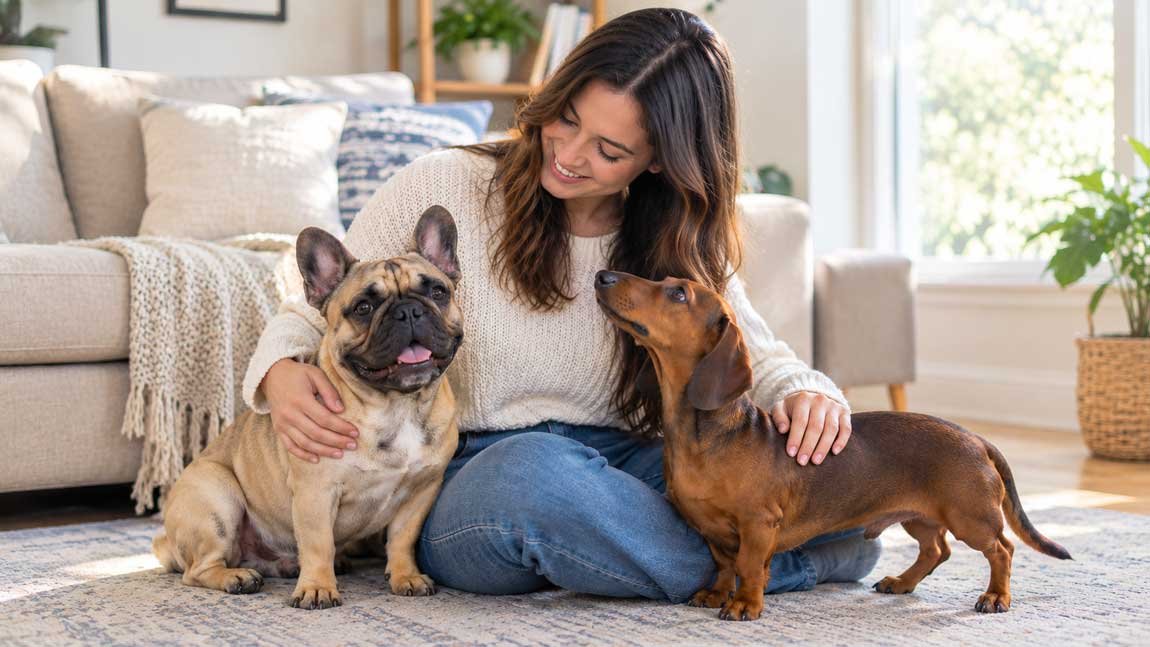
Both can be deeply affectionate.
The difference is often how they show it.
French Bulldogs frequently want physical closeness. They may sit against your leg, sleep beside you, follow you between rooms, or simply want to be near you.
Dachshunds can be extremely loving too, but many have a little more independence.
A Dachshund may happily cuddle with you and then suddenly decide it has important business to conduct somewhere else.
Neither style is better.
Some dogs are naturally cuddly. Others prefer affection on their own terms.
If you’re looking for a dog that tends to make companionship a major part of everyday life, the French Bulldog’s people-oriented nature may appeal to you.
If you enjoy a dog with affection plus a strong independent streak, a Dachshund may be a fascinating companion.
4. Exercise Needs: French Bulldog vs Dachshund
This is one area where the breeds are noticeably different.
French Bulldog exercise
French Bulldogs generally do best with moderate, controlled activity rather than intense endurance exercise.
Good activities can include:
- Short walks
- Gentle play
- Indoor games
- Training sessions
- Sniffing
- Food puzzles
- Calm exploration
The important word is controlled.
French Bulldogs are brachycephalic, meaning their skull and muzzle are shortened. This anatomy can make breathing less efficient and reduce tolerance for heat and strenuous exercise. The French Bull Dog Club of America specifically advises keeping Frenchies cool and avoiding strenuous exercise.
That doesn’t mean a Frenchie should be inactive.
It means exercise should be appropriate for the individual dog and environmental conditions.
A healthy Frenchie still needs movement.
It just doesn’t need to prove anything by running a marathon.
Dachshund exercise
Dachshunds generally benefit from regular activity.
That can include:
- Daily walks
- Sniffing games
- Training
- Indoor play
- Puzzle toys
- Supervised outdoor exploration
Because they were developed as hunting dogs, mental stimulation can be just as important as physical exercise.
A bored Dachshund may create its own project.
Unfortunately, that project could involve digging your flower bed, barking at the neighbor, or investigating something you’re fairly certain it should leave alone.
A Simple Everyday Upgrade for Walks
If you’re choosing between a French Bulldog and a Dachshund, a comfortable harness is one of those small purchases that can make everyday walks easier. Look for a well-fitted, adjustable harness that gives you good control without putting unnecessary pressure on the neck.
👉 Check out popular no-pull dog harnesses on Amazon
As an Amazon Associate, FrenchieTails may earn from qualifying purchases.
5. French Bulldog vs Dachshund for Apartment Living
Both breeds can live successfully in apartments.
But the challenges are different.
French Bulldog in an apartment
Frenchies can adapt very well to smaller living spaces.
They generally don’t need a huge yard, and many are happy with short walks, indoor play, and time with their owners.
The major concern is temperature.
A small apartment that becomes extremely hot can be dangerous for a French Bulldog.
Air conditioning, ventilation, access to water, and sensible exercise timing can be important parts of responsible Frenchie ownership.
Dachshund in an apartment
Dachshunds can also adapt well to apartment living.
Their smaller size makes them practical for many homes.
However, owners need to pay attention to:
- Barking
- Daily walks
- Mental stimulation
- Stairs
- Jumping
- Weight management
A Dachshund that doesn’t get enough stimulation may become noisy or develop unwanted behaviors.
And if your apartment is several floors up, stairs deserve particular attention because of the breed’s spinal vulnerability.
Make Their Favorite Spot More Comfortable
Whether you bring home a French Bulldog or a Dachshund, a comfortable bed can quickly become one of the most-used things in your home. Look for a washable, supportive bed that gives your dog enough room to stretch out and rest comfortably.
👉 See popular supportive dog beds on Amazon
As an Amazon Associate, FrenchieTails may earn from qualifying purchases.
6. Training: Which Is Easier?
This is a question with a slightly frustrating answer:
Neither breed is guaranteed to be easy.
Both can be smart.
Both can learn quickly.
Both can also decide that they have better ideas.
Training a French Bulldog
Frenchies often respond well to:
- Positive reinforcement
- Small treats
- Praise
- Short sessions
- Consistency
- Fun activities
Long, repetitive training sessions may cause a Frenchie to lose interest.
Keep training short and rewarding.
Five focused minutes can sometimes accomplish more than twenty minutes of repetition.
Training a Dachshund
Dachshunds are intelligent but can be independent.
Their hunting background means they were not developed simply to sit around waiting for instructions.
They may understand exactly what you want and still ask themselves:
“What’s in it for me?”
Positive reinforcement works well.
Training should include:
- Name recognition
- Recall
- Leash manners
- Basic commands
- Impulse control
- Socialization
- Barking management
- Appropriate handling
With both breeds, consistency matters more than using harsh methods.
Keep Training Rewards Close
Positive training is much easier when small rewards are always within reach. A simple treat pouch can keep training treats handy during short practice sessions at home or on walks.
👉 See dog training treat pouches on Amazon
As an Amazon Associate, FrenchieTails may earn from qualifying purchases.
7. French Bulldog vs Dachshund With Kids
Either breed can be a good family companion in the right household.
But the quality of the relationship depends heavily on how children interact with the dog.
Children should learn:
- Don’t pull ears or tails.
- Don’t climb on dogs.
- Don’t disturb a sleeping dog.
- Don’t take food away.
- Don’t chase a dog that is trying to leave.
- Don’t force hugs.
- Give the dog a quiet place to rest.
French Bulldogs and children
Many Frenchies enjoy being around families.
Their playful personalities can make them fun companions.
However, rough play should be avoided because of their physical structure and potential breathing limitations.
Dachshunds and children
Dachshunds can also be affectionate family dogs.
But their long backs require extra care.
Children should not:
- Pick them up without instruction
- Carry them around unnecessarily
- Encourage jumping
- Let them leap from furniture
- Play roughly with their backs
Young children and dogs should always be supervised.
Breed alone cannot guarantee a safe relationship.
8. French Bulldog vs Dachshund: Grooming
Neither breed needs complicated grooming in the way some heavily coated breeds do.
But both need regular care.
French Bulldog grooming
The Frenchie’s short coat is relatively simple.
Routine care can include:
- Brushing
- Bathing when needed
- Nail trimming
- Ear checks
- Dental care
- Skin checks
- Wrinkle care
The wrinkles deserve particular attention.
A wrinkle should not simply be ignored because it looks cute.
Moisture and debris can contribute to skin irritation, so owners should follow an appropriate cleaning and drying routine recommended for their individual dog.
Dachshund grooming
Grooming depends on coat type.
Smooth Dachshund
Usually the simplest coat to maintain.
Longhaired Dachshund
Needs regular brushing to reduce tangles and mats.
Wirehaired Dachshund
Has a different texture and may require more specialized grooming.
All coat types still need:
- Nail care
- Dental care
- Ear checks
- Routine veterinary care
9. Shedding: Frenchie or Dachshund?
If you’re hoping for a completely shed-free dog, neither breed is the answer.
French Bulldogs shed short hairs that can become surprisingly noticeable on dark furniture and clothing.
Dachshunds also shed, with the amount varying by coat type and individual dog.
A practical grooming routine is more useful than expecting zero hair.
A good brush, washable dog bedding, and regular cleaning can make life much easier.
A Simple Grooming Tool Worth Having
Neither breed needs an elaborate grooming routine, but regular brushing can help remove loose hair and keep the coat looking neat. A soft rubber grooming brush is a simple option many owners find convenient for short-coated dogs.
👉 See popular dog grooming brushes on Amazon
As an Amazon Associate, FrenchieTails may earn from qualifying purchases.
10. Health: The Most Important Difference
This is where prospective owners should slow down and really think.
Every dog can have health problems.
But French Bulldogs and Dachshunds have different structural risks that owners should understand before bringing one home.
French Bulldog Health
French Bulldogs are brachycephalic.
Their shortened facial structure can contribute to airway problems and reduced tolerance for heat and strenuous activity. The breed club notes that Frenchies can have less tolerance of heat, exercise, and stress because breathing is less efficient than in longer-nosed breeds.
Potential concerns can include:
- Airway and breathing problems
- Heat intolerance
- Skin problems
- Allergies
- Ear problems
- Eye problems
- Spinal abnormalities
- Joint issues
- Dental problems
The AKC’s French Bulldog health-testing recommendations also include evaluations relevant to patella, hips, heart, and eyes, along with several genetic tests available through its health-testing program.
This doesn’t mean every French Bulldog will become sick.
It means responsible owners should understand the breed’s potential risks and choose veterinary care appropriately.
A Useful Summer Comfort Item for Frenchies
French Bulldogs can be more vulnerable to overheating than many other breeds, so keeping them comfortable during warm weather is important. Along with shade, fresh water, and sensible activity, some owners use a cooling mat as an extra comfort option at home.
👉 See popular dog cooling mats on Amazon
As an Amazon Associate, FrenchieTails may earn from qualifying purchases.
11. Dachshund Health and Back Care
The Dachshund’s long body and short legs are iconic.
They are also important from a health perspective.
Intervertebral disc disease, or IVDD, is a major concern for Dachshunds. It can cause pain, weakness, difficulty walking, and in serious cases paralysis.
This is why Dachshund owners should take spinal health seriously.
Helpful habits can include:
- Keeping your Dachshund at a healthy weight
- Avoiding unnecessary jumping
- Limiting repeated stair use
- Using ramps where appropriate
- Supporting the body correctly when lifting
- Providing regular controlled exercise
- Watching for changes in movement or pain
Not every back problem is caused by jumping, and not every Dachshund will develop IVDD. Genetics also play an important role.
But the breed’s physical structure makes prevention and early attention especially important.
Give Your Dachshund a Comfortable Place to Rest
Because Dachshunds have a long-backed body shape, everyday comfort and sensible handling matter. A supportive, easy-to-access dog bed can be a useful addition to the home, especially if your dog spends a lot of time resting indoors.
👉 Explore supportive orthopedic dog beds on Amazon
As an Amazon Associate, FrenchieTails may earn from qualifying purchases.
12. Weight Management Matters for Both
Keeping either breed at a healthy weight is one of the most useful things an owner can do.
For Dachshunds, excess weight puts additional stress on an already vulnerable spine.
For French Bulldogs, extra weight can make movement and breathing more difficult.
And here’s something many new owners underestimate:
Treats count.
A few treats here.
A piece of cheese there.
A bite from your dinner.
A “special” snack because your dog looked cute.
Those calories add up.
Your veterinarian can help you determine an appropriate feeding plan and body condition for your individual dog. The AKC also recommends working with a veterinarian when assessing healthy weight and weight-loss goals.
13. Heat Tolerance
If you live in a warm part of the United States, this deserves special attention.
French Bulldogs are particularly vulnerable to heat because of their brachycephalic anatomy.
Hot weather can turn an ordinary walk into a serious situation.
During warm weather:
- Walk during cooler hours.
- Avoid intense exercise.
- Carry water.
- Provide a cool indoor environment.
- Never leave your dog in a parked car.
- Watch carefully for signs of overheating.
Dachshunds also need protection from excessive heat.
But the French Bulldog’s breathing anatomy means heat management should be a major part of daily planning.
For a Frenchie, “it’s only a short walk” isn’t always a safe assumption when temperatures are high.
14. Barking and Noise
This is another practical lifestyle difference.
French Bulldogs can certainly bark.
But many are not constantly vocal.
Dachshunds are often more alert and vocal.
They were bred to hunt and work, and many retain a strong tendency to notice sounds, movement, and unfamiliar activity.
This can be charming when your dog alerts you to something unusual.
It can be less charming when your dog believes every person walking past the house deserves a public announcement.
If you live in an apartment or townhouse, barking should be considered before choosing a Dachshund.
Training and environmental management can make a meaningful difference.
15. Which Breed Handles Being Alone Better?
This depends heavily on the individual dog.
Neither breed should be selected because you expect it to spend most of the day alone without difficulty.
French Bulldogs often form strong bonds with their people.
Dachshunds can also become very attached to their families.
If you work outside the home for long periods, consider whether you can provide:
- A midday dog walker
- A trusted family member
- Doggy daycare when appropriate
- A consistent routine
- Mental enrichment
- Enough exercise before and after work
A dog should fit your real schedule, not your ideal schedule.
16. Food and Feeding
Neither breed needs a special diet simply because it belongs to that breed.
Food should be chosen according to the dog’s:
- Age
- Body condition
- Activity level
- Health
- Veterinary recommendations
- Individual nutritional needs
French Bulldogs can be enthusiastic eaters, and Dachshunds can also gain weight if calories aren’t managed carefully.
Don’t judge feeding amounts only by how hungry your dog acts.
Some dogs would happily eat a second dinner immediately after finishing the first.
That doesn’t mean they need it.
Read: French Bulldog Feeding Guide
17. French Bulldog vs Dachshund: Cost of Ownership
The cost of owning a dog goes far beyond the purchase or adoption fee.
Your budget may need to cover:
Routine expenses
- Food
- Preventive veterinary care
- Vaccinations
- Parasite prevention
- Grooming
- Toys
- Bedding
- Training
- Dental care
Unexpected expenses
- Emergency veterinary visits
- Diagnostic tests
- Surgery
- Prescription medications
- Specialty veterinary care
French Bulldogs may require substantial veterinary planning because of their potential respiratory, skin, orthopedic, and other health concerns.
Dachshunds can also generate significant medical costs, particularly when spinal disease occurs.
That is why a realistic dog budget should include an emergency fund or appropriate pet insurance—not just the monthly food bill.
18. French Bulldog vs Dachshund for First-Time Owners
Neither breed should automatically be labeled “easy.”
A first-time owner should ask:
Can I handle this breed’s specific needs?
For a French Bulldog, that may mean:
- Heat management
- Understanding breathing limitations
- Careful exercise
- Skin and wrinkle care
- Potential veterinary expenses
For a Dachshund, that may mean:
- Back protection
- Weight control
- Regular exercise
- Barking management
- Consistent training
- Preventing unnecessary jumping
The best first dog isn’t necessarily the breed with the shortest list of potential problems.
It is the breed whose needs you understand and are prepared to meet.
19. French Bulldog vs Dachshund for Seniors
A senior owner may appreciate the companionship and manageable size of either breed.
But lifestyle and mobility should be considered carefully.
A French Bulldog may fit someone who prefers shorter walks and more indoor companionship.
A Dachshund can also be a wonderful companion, but stairs and back safety may require additional household planning.
The important question isn’t simply:
“Is this a small dog?”
It is:
“Can I comfortably handle this dog’s exercise, training, lifting, veterinary, and safety needs every day?”
20. French Bulldog vs Dachshund for Active Owners
If your dream is to spend weekends doing long hikes, running, or intense outdoor activities with your dog, neither breed should be chosen solely because it is small.
French Bulldogs generally are not built for endurance exercise, particularly in warm weather.
Dachshunds can enjoy regular walks and exploration, but their backs also require sensible exercise rather than repeated high-impact activity.
If your lifestyle is highly active, consider what kind of activity you actually want to share with your dog.
A dog that enjoys moderate walks and enrichment may fit your lifestyle better than one expected to keep up with long-distance exercise.
21. French Bulldog vs Dachshund: Daily Life With Each Breed
Sometimes the best comparison isn’t a chart.
It’s imagining an ordinary Tuesday.
A day with a French Bulldog
You wake up.
Your Frenchie is probably nearby.
You prepare breakfast while your dog watches.
After eating, you go for a short walk.
Back home, there’s some play.
You start working.
Your Frenchie settles nearby.
Later, there’s another short walk or indoor game.
Dinner.
A little family time.
Then your Frenchie finds the most comfortable place in the house and settles down.
The overall rhythm is often:
companionship → short activity → rest → companionship.
A day with a Dachshund
You wake up.
Your Dachshund wants to know what’s happening.
You go for a walk.
There are approximately 400 smells that require investigation.
Breakfast follows.
Later, you work on training or give your dog a puzzle or scent game.
Another walk.
More investigation.
Perhaps some barking because someone exists outside.
Eventually, your Dachshund curls up beside you.
The rhythm may be:
explore → investigate → train → play → explore → cuddle.
Again, these are tendencies, not guarantees.
Individual dogs can be completely different.
22. French Bulldog vs Dachshund: Which Is Better With Other Pets?
Both breeds can live successfully with other dogs when properly introduced and socialized.
But Dachshunds can have a stronger prey-drive background because of their hunting history.
That means households with small animals should consider the individual dog’s behavior carefully.
French Bulldogs can also have strong personalities and may play differently from other dogs.
Successful multi-pet homes depend on:
- Proper introductions
- Supervision
- Individual temperament
- Socialization
- Separate feeding areas
- Safe spaces
- Respecting boundaries
Don’t assume that two small dogs will automatically become best friends.
Give the relationship time.
23. French Bulldog vs Dachshund: Pros and Cons
French Bulldog Pros
- Very affectionate
- People-oriented
- Entertaining personality
- Usually comfortable with moderate activity
- Can adapt well to apartment living
- Compact and sturdy
- Often enjoys family companionship
- Doesn’t require long endurance exercise
French Bulldog Cons
- Significant heat sensitivity
- Potential breathing problems
- Possible skin and allergy issues
- Can have expensive veterinary needs
- Can be stubborn
- Needs appropriate wrinkle and skin care
- Not suitable for intense exercise
- Swimming can be particularly risky because of body structure
Dachshund Pros
- Intelligent
- Curious
- Confident
- Entertaining
- Affectionate
- Small and portable
- Enjoys walks and exploration
- Available in multiple coat varieties
- Can adapt well to apartment living
Dachshund Cons
- Can be stubborn
- Can be vocal
- Needs consistent training
- Spinal health requires special attention
- Jumping and stairs may need management
- Can gain weight easily
- May chase small animals
- Can become bored without mental stimulation
24. Which Dog Is Better for an Apartment?
If your main priority is a companion that can comfortably spend much of its time indoors, a French Bulldog may naturally fit that lifestyle.
But that doesn’t make a Dachshund unsuitable for an apartment.
A Dachshund can thrive in an apartment when it receives enough exercise, mental stimulation, training, and appropriate back protection.
The bigger question is:
What kind of apartment owner are you?
If you prefer quiet evenings, short walks, and lots of couch time, a Frenchie may feel more natural.
If you enjoy regular walks, training, sniffing games, and a more alert little companion, a Dachshund may fit your routine.
25. Which Dog Is Better for a Busy Family?
A busy family needs to be realistic.
Neither breed should be treated like a low-maintenance accessory.
Families should have a plan for:
- Feeding
- Exercise
- Training
- Veterinary visits
- Grooming
- Vacation care
- Emergency situations
- Daily companionship
A French Bulldog may enjoy being involved in family activities but still needs careful temperature management.
A Dachshund may enjoy family life but needs appropriate exercise and spinal protection.
The family that succeeds isn’t necessarily the one with the “easier” breed.
It’s the one with a realistic routine.
26. What About Puppies?
This is where many people make a mistake.
They compare adult dogs and forget that puppies are completely different.
A French Bulldog puppy can be energetic, mouthy, curious, and difficult to potty train.
A Dachshund puppy can be equally energetic and may have plenty of opinions about everything.
Puppy ownership means:
- House training
- Socialization
- Bite inhibition
- Crate training
- Safe exercise
- Veterinary care
- Vaccinations
- Training
- Sleep schedules
- Puppy-proofing the home
Don’t choose a breed because you think the puppy stage will be easy.
Choose the breed whose adult needs you are prepared to support.
27. How to Choose a Responsible Breeder or Rescue
If you’re getting a puppy, don’t make your decision based only on photos, color, price, or availability.
Ask questions.
For a breeder, ask about:
- Health testing
- Parents’ health history
- Genetic testing where appropriate
- Veterinary records
- Socialization
- Living conditions
- Contracts and health guarantees
- How puppies are raised
The AKC recommends breed-relevant health testing for French Bulldog breeding stock, including patella, hip, cardiac, and ophthalmologist evaluations recommended through the breed-club guidance.
For a Dachshund, ask specifically about family history and spinal health.
A responsible breeder should be comfortable discussing health rather than trying to avoid the subject.
And don’t forget rescue.
Adult dogs in shelters and breed-specific rescues can make wonderful companions, and their established personalities can sometimes make lifestyle matching easier.
28. French Bulldog vs Dachshund: The Questions You Should Ask Yourself
Before choosing, sit down and answer these honestly.
How active am I?
Do I enjoy short walks or long outdoor adventures?
How much time will my dog spend alone?
Be realistic.
Do I live somewhere hot?
If yes, French Bulldog heat management deserves serious consideration.
Do I have stairs?
If you are considering a Dachshund, think about how those stairs will be managed.
Do I have young children?
Think about supervision and safe dog handling.
Can I afford unexpected veterinary care?
This is important for every dog.
Do I want a cuddly companion?
Frenchies often thrive on close human companionship.
Do I want a curious little explorer?
Dachshunds can bring plenty of that personality.
Can I commit for the dog’s entire life?
This is the most important question of all.
French Bulldog vs Dachshund: Which One Is Right for You?
After looking at all the differences, the answer becomes much clearer.
A French Bulldog may fit your lifestyle if you want a close, affectionate companion who enjoys family life, moderate activity, indoor living, and plenty of time with people. You also need to be comfortable managing heat carefully and understanding the health considerations associated with the breed’s short-muzzled structure.
A Dachshund may fit your lifestyle if you want a curious, confident, playful dog that enjoys walks, exploration, training, and mental stimulation. You also need to be prepared to protect its back, manage its weight, and work consistently on training and barking.
Neither dog is automatically the right choice for everyone.
And that’s actually good news.
Choosing a dog shouldn’t be about finding the breed that wins a popularity contest.
It should be about finding the dog whose needs match your life.
Final Thoughts
The French Bulldog vs Dachshund comparison is really a comparison between two very different kinds of small dogs.
The French Bulldog is often the affectionate home companion—the dog that wants to be involved in your day, whether you’re working, relaxing, or simply walking from one room to another.
The Dachshund is the tiny adventurer—the dog that may turn a normal walk into a full investigation and remind you that small dogs can have enormous personalities.
Both can make wonderful companions.
Both can be funny.
Both can be stubborn.
Both can be deeply affectionate.
And both deserve owners who understand their specific needs.
If you’re choosing between them, don’t choose based only on appearance.
Think about your home.
Think about your schedule.
Think about your activity level.
Think about your children and other pets.
Think about summer temperatures.
Think about stairs and jumping.
Think about training.
Think about veterinary expenses.
And think about what life with that dog will look like five years from now—not just on the day you bring the puppy home.
The best match is not the breed that looks perfect on a screen.
It’s the dog whose personality and needs you are genuinely ready to live with, care for, and love every day.
Frequently Asked Questions About French Bulldog vs Dachshund
Is a French Bulldog bigger than a Dachshund?
They have very different body structures. An adult French Bulldog should not exceed 28 pounds under the AKC breed standard. Standard Dachshunds are usually 16–32 pounds, while miniature Dachshunds are 11 pounds or under at 12 months and older.
Is a French Bulldog calmer than a Dachshund?
French Bulldogs often have a more companion-oriented lifestyle, while Dachshunds tend to be more curious, alert, and investigative. Individual temperament can vary considerably.
Which dog needs more exercise?
Dachshunds generally benefit from more regular walking and mental stimulation. French Bulldogs also need daily activity but are not suited to strenuous endurance exercise, particularly in hot weather.
Which is easier to train, a French Bulldog or Dachshund?
Both can be intelligent and stubborn. French Bulldogs often respond well to short, positive sessions, while Dachshunds may require extra patience because of their independent nature.
Are French Bulldogs good apartment dogs?
They can be excellent apartment companions when their exercise, enrichment, temperature, and veterinary needs are properly managed.
Are Dachshunds good apartment dogs?
Yes. Dachshunds can adapt well to apartment living when they receive enough exercise and mental stimulation. Their access to stairs and opportunities for repeated jumping should be managed because of spinal-health concerns.
Which breed is better with children?
Both can live successfully with respectful children. Supervision, socialization, and teaching children how to handle dogs safely are essential.
Which has more health concerns?
Both breeds have important breed-specific health considerations. French Bulldogs have particular concerns involving breathing and heat tolerance, while Dachshunds have a notable risk of spinal disease such as IVDD.
Can a French Bulldog and Dachshund live together?
Yes. Many can live together successfully with proper introductions, socialization, supervision, and management. Individual temperament matters more than breed labels alone.
Which is better for a first-time dog owner?
There is no universal answer. A first-time owner should choose based on lifestyle, time, budget, training commitment, and willingness to manage the breed’s specific health and safety needs.
Which dog is better for hot climates?
Neither breed should be exposed to dangerous heat, but French Bulldogs require especially careful heat management because their short-muzzled anatomy can reduce their ability to cool themselves efficiently.
Which dog sheds more?
Both shed. French Bulldogs have a short coat, while Dachshunds come in smooth, longhaired, and wirehaired varieties. Shedding varies between individual dogs and coat types.
Are Dachshunds prone to back problems?
Yes. IVDD is an important health concern in Dachshunds. Maintaining a healthy weight, limiting unnecessary jumping, and paying attention to changes in mobility can help owners manage spinal-health risks.
Are French Bulldogs expensive to own?
They can be. Routine costs are similar to other dogs, but potential breed-related veterinary care can increase total ownership costs. Prospective owners should plan for both routine care and unexpected veterinary expenses.
A Final Word From FrenchieTails
Choosing a dog is a long-term relationship, not a quick purchase.
Take your time.
Meet adult dogs when possible.
Talk to veterinarians and responsible breeders or rescues.
Ask difficult health questions.
Look beyond the cute face.
And choose with the dog’s future in mind.
Because when you get the match right, the comparison eventually stops mattering.
You simply end up with your dog.