How to Train a Stubborn French Bulldog: Simple Tips for Success
Training a French Bulldog can sometimes test your patience. One minute your Frenchie seems ready to learn, and the next minute they are sitting on the floor looking at you as if your training session was never part of the plan.
That does not necessarily mean your dog is stubborn or unwilling to learn.
French Bulldogs are playful, intelligent, adaptable companion dogs, and many enjoy learning when training is rewarding and consistent. Their reputation for being stubborn often comes from their independent personality, distractions, low motivation, or simply not understanding what we are asking.
The good news is that you do not need harsh corrections or long training sessions to teach your Frenchie. Reward-based training, clear communication, consistency, and realistic expectations can make training much easier.
This guide covers the basics, including obedience training, leash walking, potty training, socialization, barking, separation-related behavior, and what to do when your French Bulldog seems to ignore you.
Understanding Your French Bulldog’s Personality
Before changing your dog’s behavior, it helps to understand what may be happening.
French Bulldogs are generally playful, alert, adaptable, and affectionate companion dogs. They can also have strong preferences about what they want to do, which is one reason some owners describe them as stubborn.
Instead of asking, “How do I make my Frenchie obey?” try asking:
“How can I make the behavior I want easy and worthwhile for my dog?”
That small change in approach can make training much more productive.
A few things to remember:
- Motivation matters: Some Frenchies work harder for small treats, while others prefer toys, praise, attention, or play.
- Short sessions work well: A few focused minutes can be more useful than a long session when your dog is losing interest.
- Consistency matters: Everyone in the household should use the same cues and rules.
- Environment matters: A command that works in a quiet room may be much harder in a busy park.
- Every dog is different: Age, previous experience, health, personality, and distractions can all affect learning.
If your dog suddenly stops responding to familiar cues or shows a major change in behavior, talk with your veterinarian. Pain or other medical problems can sometimes affect behavior.
The Most Important Training Rule: Reward the Behavior You Want
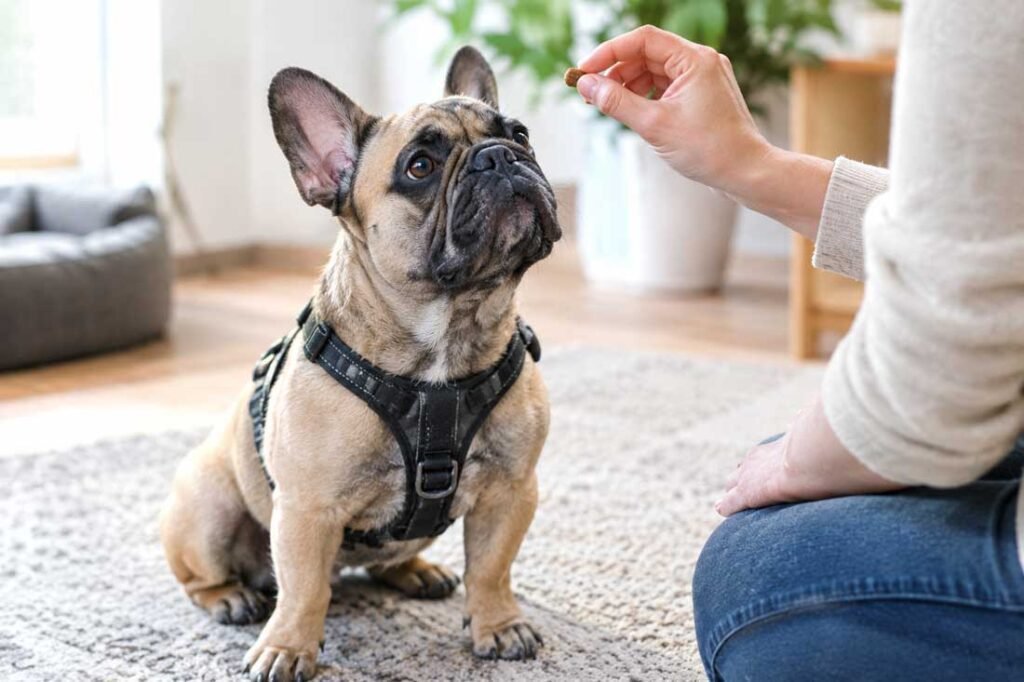
Reward-based training teaches your dog that a behavior you like leads to something valuable.
That reward might be a small treat, praise, a favorite toy, play, or access to something your dog enjoys. The important part is timing: reward the behavior you want as soon as possible so your Frenchie can understand what earned the reward.
For example, if you are teaching “sit”:
- Hold a small treat near your dog’s nose.
- Move it slowly upward and slightly back.
- When your dog sits, immediately mark the behavior with praise such as “Yes!”
- Give the reward.
- Repeat several times.
- Add the word “sit” once your dog begins to understand the movement.
Keep the lesson short and end while your dog is still interested.
What about punishment?
Avoid yelling, hitting, leash jerks, or training methods based on fear or pain. The American Veterinary Society of Animal Behavior recommends reward-based methods for dog training and behavior modification and advises against aversive training methods.
If you are frustrated, take a break. Training should be a learning experience, not a battle.
1. Keep Training Sessions Short and Consistent
French Bulldogs do not need marathon training sessions.
Start with a few minutes at a time and practice regularly. Once your dog understands a behavior, slowly practice it in different places and around gradually increasing distractions.
A simple routine might look like this:
Morning: Practice “sit” and “wait” for a few minutes.
During the day: Reward calm behavior, coming when called, or going to a bed or mat.
Evening: Practice leash skills or another simple behavior.
Short practice throughout the day can fit naturally into your dog’s routine.
2. Use One Clear Cue for Each Behavior
Avoid changing commands from one repetition to another.
If you use “come,” don’t sometimes use “come here,” “get over here,” and your dog’s name for the same behavior.
Choose a cue and use it consistently.
Also avoid repeating a command again and again:
“Sit… sit… SIT… SIT!”
Instead, give the cue once, help your dog succeed if needed, and reward the correct response.
Consistency helps your Frenchie understand exactly what you expect.
3. Make Rewards Worth Working For
Not every reward has the same value to every dog.
Your Frenchie may love tiny soft treats but ignore dry kibble during training. Another dog may work harder for a favorite toy or a short game.
Try different rewards and see what motivates your dog.
Use small treats during training, especially when you are doing several repetitions. You can also use part of your dog’s regular food as training rewards when appropriate.
As your dog becomes more reliable, you can gradually vary the rewards while continuing to praise and reinforce good behavior. Reward schedules can be adjusted as a behavior becomes established.
Recommended Training Treats for French Bulldogs
Look for small, soft treats that can be broken into tiny pieces for repeated training.
→ Check Training Treats on Amazon
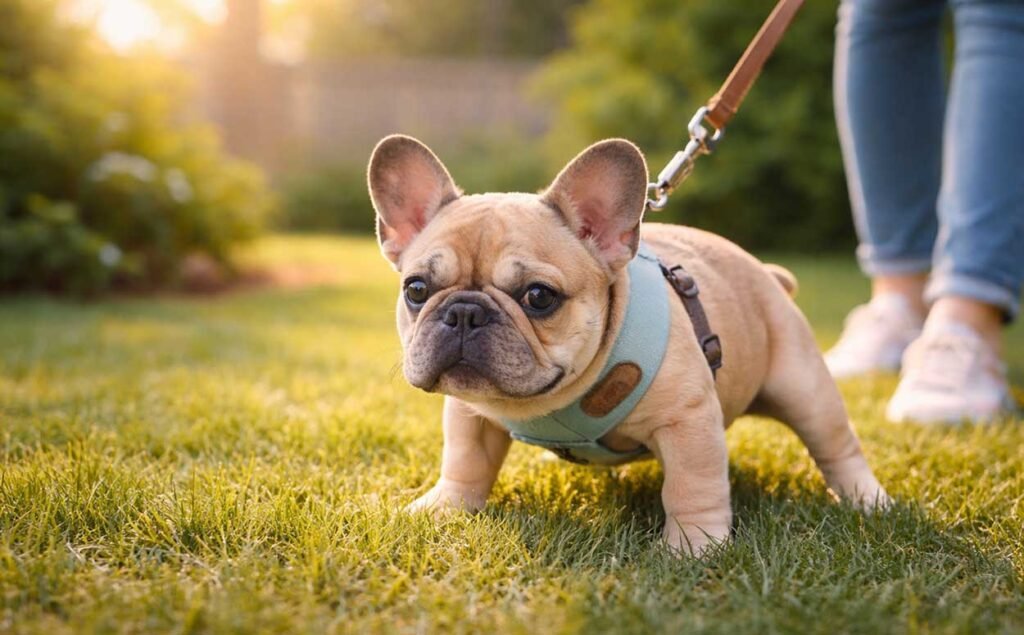
4. Leash Training: Skip the Struggle
Leash walking should be taught as a skill, not treated as a power struggle.
For a French Bulldog, a well-fitted harness can be a useful option for walking because it avoids putting training pressure directly on the neck.
A Frenchie-Friendly Walking Setup
Look for a properly fitted harness that allows comfortable movement without putting training pressure directly on the neck.
See Dog Harness Options on Amazon
Do not rely on a slip lead or leash corrections to force your Frenchie to walk. Reward-based training is a better approach for teaching loose-leash walking.
Start indoors
- Let your dog become comfortable wearing the harness.
- Reward your Frenchie for looking at you.
- Take a few steps and reward your dog for staying near you.
- Stop if your dog pulls hard.
- Resume walking when the leash becomes loose.
- Gradually practice in a quiet outdoor area.
- Increase distractions slowly.
Keep walks appropriate for your individual Frenchie’s fitness and the weather. French Bulldogs have short muzzles and can have more difficulty coping with heat and strenuous exercise than many longer-nosed breeds.
5. Potty Training Without Frustration
Potty training works best when you prevent accidents, provide frequent opportunities to go outside, and reward the correct behavior.
Create a predictable routine
Take your Frenchie outside:
- after waking up
- after meals
- after drinking a lot of water
- after naps
- after play
- before bedtime
- whenever you notice signs that your dog needs to go
Take your dog to the same general potty area and give them time to sniff and settle.
When your dog finishes, reward them immediately.
What if an accident happens?
Do not punish your dog after the fact. Your dog may not understand what the punishment is for.
Clean the area thoroughly and adjust your routine to reduce the chance of another accident.
If a previously house-trained dog suddenly starts having frequent accidents, contact your veterinarian because a medical problem can sometimes cause changes in bathroom habits.
6. Teach Basic Commands First
You do not need dozens of commands.
Start with useful everyday behaviors such as:
- Sit
- Down
- Stay
- Come
- Leave it
- Drop it
- Wait
- Go to bed
- Walk nicely on leash
These skills can make everyday life easier and can give your Frenchie a better way to respond in situations where excitement or distractions are high.
Teach one behavior at a time and build gradually.
7. Mental Stimulation Can Make Training Easier
Training is not only about obedience.
French Bulldogs benefit from activities that give them something appropriate to think about. Puzzle toys, scent games, food-dispensing toys, simple tricks, and short training sessions can provide mental stimulation.
Try a simple game:
Find It
- Let your dog see a small treat.
- Toss it a short distance.
- Say “find it.”
- Let your dog search for it.
- Praise them when they find it.
As your dog improves, hide treats in slightly harder places.
Mental games can be especially useful on days when weather makes a long outdoor walk inappropriate. French Bulldogs should not be pushed into strenuous exercise in hot conditions.
Try a Beginner Puzzle Toy
If your Frenchie enjoys food-based games, a simple puzzle feeder can turn part of their daily food into a short mental workout.
8. Socialization: Focus on Positive Experiences
Socialization is more than making your dog meet as many people and dogs as possible.
The goal is to help your Frenchie become comfortable with different people, environments, sounds, surfaces, handling, and everyday situations.
Keep new experiences positive and manageable.
For example, if your puppy is nervous around a busy sidewalk, you do not need to force them into the middle of the crowd. Start at a comfortable distance, reward calm behavior, and gradually reduce the distance as your dog becomes more comfortable.
Quality matters more than overwhelming your dog with constant exposure.
Early exposure to people, places, and situations is an important part of puppy development, while training should continue as your dog grows.
9. How to Handle Excessive Barking
Before trying to stop barking, figure out why your dog is barking.
Your Frenchie might be barking because of:
- excitement
- attention-seeking
- fear
- frustration
- boredom
- unfamiliar sounds
- seeing people or animals outside
- discomfort
Simply yelling “quiet!” may not solve the underlying problem.
Instead, identify the trigger and teach an alternative behavior.
For example, if your dog barks when someone walks past the window, close the blinds or create more distance, then reward your dog for looking at you or settling quietly.
If barking is sudden, intense, or connected to fear or aggression, consider getting help from a qualified professional.
10. What to Do About Jumping on People
Jumping often works because the dog gets attention when they do it.
Instead of pushing your dog away or yelling, teach an alternative behavior such as sitting for greetings.
Practice with family members first:
- Approach your dog.
- Ask for a sit.
- Reward the sit.
- If your dog jumps, calmly remove attention.
- Try again.
- Reward the calm greeting.
Everyone who interacts with your dog should follow the same rule.
11. Chewing and Destructive Behavior
Chewing is normal dog behavior, but your Frenchie needs appropriate things to chew.
Keep tempting objects such as shoes, remote controls, children’s toys, and unsafe household items out of reach.
When your dog chooses an appropriate chew toy, praise and reward that choice.
If your Frenchie grabs something they should not have, calmly trade it for an appropriate item rather than turning it into a chase game.
This teaches your dog what they can chew instead of simply telling them what not to chew.
If your Frenchie needs something appropriate to chew, choose a toy that matches their chewing style and size, and supervise use. Replace it if pieces begin to break off.
Recommended: Durable Enrichment Toy
→ See options on Amazon
12. Separation-Related Behavior
Some dogs become distressed when left alone.
Signs can include:
- barking or howling after you leave
- destructive behavior
- pacing
- repeated attempts to escape
- house-soiling when alone
- extreme distress around departures
Do not assume that a dog showing these signs is simply being “clingy” or stubborn.
For mild separation-related problems, gradual practice with short absences can help some dogs learn that being alone is safe. Departures should be kept short enough that the dog remains calm, then increased gradually.
If your dog panics, injures themselves, destroys doors or windows, or cannot tolerate even very short absences, speak with your veterinarian or a qualified behavior professional rather than trying to push through the problem.
For dogs that enjoy food enrichment, a lick mat or stuffed food toy can provide an appropriate activity during short, calm alone-time practice.
13. When Your French Bulldog Seems to Ignore You
Sometimes your Frenchie really does seem to hear the command and choose to do something else.
Before calling the dog stubborn, check these five things:
Is the environment too distracting?
Try training somewhere quieter.
Is the reward valuable enough?
Try a different reward.
Does your dog understand the cue?
Go back to an easier version of the behavior.
Is the session too long?
Take a break.
Could your dog be uncomfortable or unwell?
A sudden change in behavior deserves attention, especially if it happens with other changes such as pain, reduced appetite, unusual tiredness, or changes in normal activity.
Training problems are not always training problems.
14. When to Get Professional Help
You do not have to solve every behavior problem by yourself.
Consider working with a qualified, reward-based trainer if you are struggling with:
- serious leash problems
- fear
- reactivity
- resource guarding
- aggression
- severe separation-related behavior
- behavior that is getting worse
- training that has stopped making progress
For serious aggression, sudden behavior changes, or suspected medical causes, start by talking with your veterinarian.
When choosing a trainer, ask what methods they use. Look for professionals who explain their methods clearly and use reward-based training. AVSAB recommends reward-based methods and provides guidance for choosing trainers.
A Simple Daily Training Routine for Your Frenchie
You do not need to turn your whole day into a training class.
Try building training into normal life.
Morning
Practice one simple cue such as sit, wait, or come.
During meals
Use a few pieces of your dog’s food for simple training when appropriate.
During walks
Reward your dog for checking in with you and walking with a loose leash.
During play
Practice drop it, leave it, or recall.
Evening
Spend a few minutes on a puzzle toy, scent game, or trick training.
Small moments of practice add up.
Common French Bulldog Training Mistakes to Avoid
Training for too long
Long sessions can lead to frustration and loss of focus.
Repeating commands
Repeating a cue teaches your dog that they do not need to respond the first time.
Changing the rules
If jumping on the couch is allowed one day but punished the next, your dog receives mixed information.
Rewarding unwanted behavior by accident
Giving attention, treats, or access to something your dog wants immediately after unwanted behavior can accidentally reinforce it.
Using physical punishment
Fear and pain are not necessary for teaching a dog basic skills. Reward-based training is recommended by veterinary behavior experts.
Expecting instant results
Training is a process. A behavior that works perfectly at home may need more practice around distractions.
Final Thoughts: How to Train a Stubborn French Bulldog
Training a French Bulldog does not have to become a battle of wills.
Your Frenchie may have an independent side, but that does not mean they cannot learn. Start with small behaviors, use rewards your dog actually values, keep sessions short, and practice consistently.
Most importantly, look at training as communication rather than control. When your dog understands what you want and has a good reason to repeat the behavior, learning becomes much easier.
And if a behavior suddenly changes, becomes extreme, or involves fear, aggression, pain, or severe anxiety, don’t simply label your Frenchie “stubborn.” A veterinarian or qualified behavior professional can help identify what is really going on.
Every dog learns at a different pace. Celebrate the small wins, keep training positive, and enjoy the process of building a better relationship with your Frenchie.
Frequently Asked Questions
Are French Bulldogs hard to train?
French Bulldogs are not necessarily difficult to train, but individual dogs vary. They can be playful, intelligent, and willing to learn, while some may become distracted or lose interest quickly. Short, consistent, reward-based sessions can help.
What is the best way to train a stubborn French Bulldog?
Start with reward-based training. Use a clear cue, reward the behavior you want, keep sessions short, and practice consistently. If your dog struggles, make the exercise easier instead of simply repeating the command.
How long should I train my French Bulldog each day?
There is no single perfect training time for every dog. Several short sessions throughout the day can be easier for a Frenchie than one long session. Stop while your dog is still engaged and willing to participate.
How do I stop my French Bulldog from pulling on the leash?
Start in a quiet environment and reward your dog for staying near you with a loose leash. Gradually increase distractions and distance. A properly fitted harness can be useful for walking. Avoid leash jerks and other aversive corrections.
How do I potty train a French Bulldog?
Take your dog outside on a predictable schedule, especially after waking, eating, drinking, playing, and sleeping. Reward your dog immediately after they eliminate in the correct place. Do not punish accidents after they happen.
How do I stop my French Bulldog from barking?
First identify why your dog is barking. Then manage the trigger and reward an alternative calm behavior. If barking is connected to fear, aggression, or severe distress, consider professional help.
Can I train an adult French Bulldog?
Yes. Dogs can continue learning throughout their lives. Adult dogs may need extra time to change established habits, but consistent reward-based training can still teach new behaviors.
What should I do if my French Bulldog suddenly becomes difficult to train?
A sudden change in behavior should not automatically be blamed on stubbornness. Pain, illness, fear, stress, or changes in the environment can affect behavior. If the change is unusual or persistent, talk with your veterinarian.
When should I hire a professional dog trainer?
Consider professional help when you are dealing with serious fear, aggression, reactivity, resource guarding, severe separation-related behavior, or a problem that is not improving. Look for a trainer who uses reward-based methods and can explain their approach clearly.