French Bulldog Puppy Biting: Why It Happens & How to Stop It
French Bulldog Puppy Biting: If you have a French Bulldog puppy, you may have already discovered that those little wrinkles come with some surprisingly sharp teeth.
One minute your puppy is cuddling beside you. The next, they are chewing on your fingers, grabbing your pant leg, or chasing your ankles around the house.
It can be frustrating, especially when you are doing your best to raise a friendly and well-mannered dog. But puppy biting is usually a normal part of growing up. French Bulldog puppies use their mouths to explore, play, interact, and soothe the discomfort of teething.
That does not mean you should simply wait for the biting to disappear.
Your puppy needs to learn an important lesson: people are not chew toys, and human skin should be treated gently.
The good news is that you can teach this without scolding, hitting, or frightening your puppy. With the right routine, appropriate chew outlets, and consistent responses, most families can make a big difference.
Because French Bulldog puppies often spend a lot of time close to their families during play, cuddling, and everyday activities, your hands, sleeves, and feet can become easy targets. The goal is not to discourage normal puppy behavior, but to teach your Frenchie where chewing and biting are appropriate.
Why Is My French Bulldog Puppy Biting?
Before trying to stop the behavior, it helps to understand what is behind it.
Not every puppy bites for the same reason. Sometimes the answer is as simple as, “My puppy is tired and has completely lost their mind.”
Here are some of the most common reasons.
-
Your puppy is teething
Teething is one of the biggest reasons puppies become especially mouthy.
As puppy teeth develop and eventually make way for adult teeth, chewing can become very appealing. Your hands, sleeves, shoes, and furniture may all suddenly look like excellent chew toys.
Providing a few puppy-safe chew toys for teething gives your puppy somewhere safe to direct that urge.
-
Your puppy is playing
Puppies learn a lot about play by using their mouths.
A young Frenchie may grab your fingers during a game, chase your feet as you walk, or gently bite your sleeve because they want you to interact with them.
The problem is not that your puppy wants to play. The problem is that they have not yet learned which things are appropriate to bite.
-
Your puppy is overtired
This one surprises many new puppy owners.
A puppy that has been awake too long can become incredibly mouthy. Instead of looking sleepy, they may suddenly race around the house, grab everything, and bite much harder than usual.
If your puppy seems to turn into a tiny land shark in the evening, consider whether they actually need a quiet break or nap.
-
Your puppy wants attention
Even negative attention can sometimes be interesting to a puppy.
If biting your hand makes you jump, talk, push them away, or chase them, your puppy may learn that biting is a reliable way to start a game.
This is why your response matters.
-
Your puppy is excited or overstimulated
Visitors, toys, children, new surroundings, and exciting play can all push a puppy’s arousal level higher.
Once a puppy becomes too excited, listening can become much harder. At that point, repeatedly saying “no” may not teach much.
It is usually more helpful to lower the excitement and give the puppy a simple behavior or safe activity to focus on.
-
Your puppy is exploring
Puppies investigate their environment with their mouths. That is normal.
They are not born knowing that your fingers are different from a chew toy.
Teaching that difference is part of puppy training.
What Is Bite Inhibition?
Bite inhibition means learning to control how hard a dog uses its mouth. Puppies naturally explore and play with their mouths, but they also need to learn that human skin should be treated gently.
The goal is not to frighten your puppy or punish every mouthy moment. Instead, you want to teach your Frenchie that gentle interaction keeps the fun going, while hard biting makes the interaction stop. This is one reason calm redirection, brief pauses, and rewarding appropriate behavior are so useful during puppyhood.
Is French Bulldog Puppy Biting a Sign of Aggression?
“Puppy biting is not automatically aggression”
A puppy that happily grabs your hands during play is not automatically showing aggression. Puppy mouthing can be a normal part of play and development, but the context, body language, and intensity of the behavior matter.
Pay closer attention if biting is accompanied by:
- A very stiff or frozen body
- Repeated intense growling
- Guarding food, toys, or resting places
- Fearful attempts to escape
- Sudden changes in behavior
- Bites that are becoming increasingly hard or unpredictable
- Biting associated with handling or apparent pain
A sudden behavior change is especially worth discussing with your veterinarian because pain or illness can affect a dog’s behavior.
When in doubt, do not try to diagnose aggression yourself. A veterinarian or qualified behavior professional can help determine what is actually happening.
How to Stop French Bulldog Puppy Biting
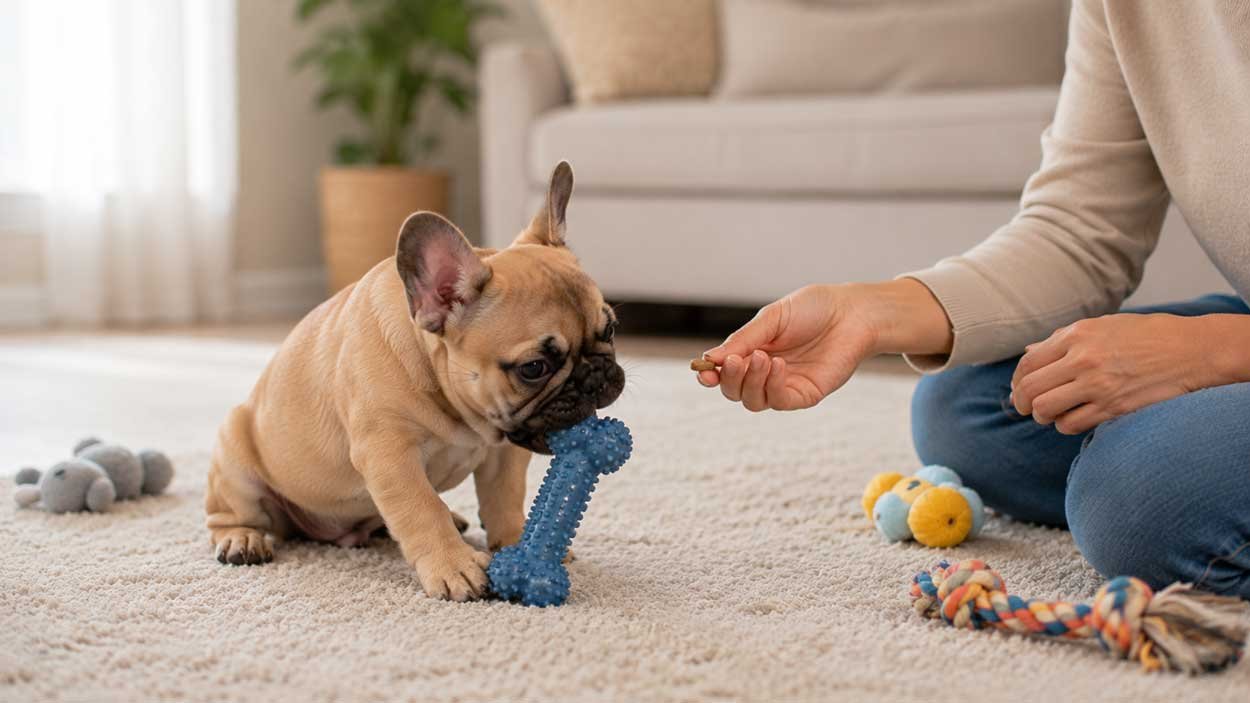
The goal is not simply to tell your puppy, “Don’t bite.”
Your puppy needs to understand what to do instead.
Try this simple approach.
Step 1: Keep a toy within reach
Do not wait until your puppy has your hand in their mouth.
Keep a few durable puppy toys for chewing and redirection in the areas where your puppy spends the most time.
If your Frenchie starts reaching for your fingers, calmly put a suitable toy in front of them.
When they choose the toy, praise them.
Over time, your puppy starts learning:
People = gentle interaction.
Toys = biting and chewing.
That distinction is much easier for a puppy to understand than a long lecture about what they did wrong.
Step 2: Make biting end the fun
If your puppy bites during play, calmly stop interacting. Once your puppy settles, restart the game with an appropriate puppy tug toy rather than your hands.
You can:
- Stop moving your hands
- Stand up
- Turn away
- Remove your attention briefly
Wait for your puppy to settle, then try again with a toy or another calm activity.
The American Kennel Club recommends making biting a signal that play ends, while also noting that some puppies become more excited when people make a high-pitched “ouch.” If that happens with your puppy, quietly turning away or walking away is a better choice.
The important part is consistency.
If biting sometimes produces a fun wrestling match and other times ends the game, your puppy receives a confusing message.
Step 3: Reward the behavior you want
This is one of the easiest things for owners to forget.
We tend to notice puppies when they are doing something wrong.
But what about the moments when your Frenchie is lying quietly, chewing their own toy, or sitting beside you without using their teeth?
Those moments are worth rewarding.
A calm “Good job,” a small training treat for puppies, gentle praise, or access to a favorite toy can tell your puppy: Yes, this is the behavior I want.
Reward-based training is recommended by the American Veterinary Society of Animal Behavior (AVSAB) for dog training and behavior modification. AVSAB recommends avoiding aversive training methods and instead using approaches that reinforce behaviors you want to see.
Step 4: Watch for the “too tired” puppy
If biting gets worse at a particular time of day, start keeping a simple note.
For example:
7:00 p.m. — puppy becomes wild, bites socks, ignores toys, cannot settle.
That pattern may tell you more than you realize.
Instead of starting another exciting game, try a potty break, quiet chew, calm crate or pen time, or a nap.
Sometimes the best training session is actually sleep.
Step 5: Give your puppy legal things to chew
A puppy needs appropriate outlets for chewing.
Depending on your veterinarian’s advice and your puppy’s size and chewing habits, options may include puppy-safe rubber chew toys, food-stuffed toys, age-appropriate teething toys, and durable toys designed for supervised chewing.
Inspect toys regularly. Throw away anything that is damaged, breaking apart, or producing pieces your puppy could swallow. The AKC also recommends checking toys for damage and avoiding items that can easily break into hazardous pieces.
There is no single chew toy that is safe for every puppy. Choose toys that match your puppy’s size, chewing style, and age, and supervise chewing whenever there is a risk of pieces breaking off.
You do not need a giant basket of toys.
A few safe options that you rotate can be more useful than twenty toys scattered around the house.
What If My French Bulldog Puppy Bites My Hands?
This is one of the most common complaints from new puppy owners.
Imagine you are sitting on the couch. Your puppy climbs into your lap, starts licking your hand, and then suddenly—chomp.
Your natural reaction may be to pull your hand away quickly.
Unfortunately, fast-moving hands can become even more exciting to a playful puppy.
If your puppy is already very excited, avoid waving your hands around or repeatedly pushing them away. That can accidentally turn the moment into a game.
Instead, try to keep your movements calm.
If the puppy continues:
- Stop the interaction.
- Move your hands out of reach.
- Wait briefly for calm.
- Offer an appropriate toy.
- Praise your puppy for choosing the toy.
Do not turn the moment into a wrestling match.
If your puppy repeatedly attacks your hands during play, switch to games where a long interactive puppy toy creates more distance between your hands and the puppy’s mouth.
What If My Frenchie Bites My Feet or Ankles?
Ankle biting can be particularly annoying because the movement of your legs can make the game even more exciting.
If your puppy starts chasing your feet:
Stop moving if it is safe to do so.
Then redirect your puppy to something appropriate.
You can also teach a simple alternative behavior such as:
- “Sit”
- “Touch”
- “Find it”
- Looking at you when called
For example, before walking across the room, ask for a sit and reward it. Then take a few steps.
If your puppy stays calm, reward again.
You are gradually teaching your puppy that following you calmly is more rewarding than attacking your socks.
Should You Say “No” When Your Puppy Bites?
You can interrupt unwanted behavior, but repeatedly saying “no” is rarely enough to teach a puppy what you actually want.
Think about it from your puppy’s perspective.
If you say:
“No! Don’t bite!”
Your puppy may understand that you are unhappy, but they still have no idea whether they should sit, chew a toy, move away, or do something else.
A better training sequence is:
Interrupt → redirect → reward.
For example:
Puppy bites your hand → interaction stops → toy appears → puppy bites toy → praise.
That gives your puppy useful information.
Should You Yell, Hit, or Hold Your Puppy Down?
No.
Physical punishment may stop a behavior temporarily in some situations, but it can also create fear and damage trust.
It is particularly unhelpful when the underlying problem is fear, stress, or confusion.
AVSAB recommends reward-based training and warns against aversive training methods because of their potential welfare and behavior risks.
Your Frenchie does not need to be scared of you to learn good manners.
Calm, predictable training is a much better foundation.
A Simple 7-Day Plan for Puppy Biting
This is not a seven-day cure. Think of it as seven days of focused practice that you can repeat and adjust as your puppy grows.
You do not need to train for an hour every day.
Short repetitions throughout normal life can be much easier.
Day 1: Set up the house
Put appropriate chew toys in the rooms where your puppy spends time.
Remove tempting shoes, socks, cords, and other items.
Day 2: Practice toy redirection
During calm play, offer a toy before your puppy starts biting your hands.
Praise the puppy for choosing it.
Day 3: Practice the “game ends” rule
If teeth touch skin, calmly stop the game.
Wait for calm, then restart with an appropriate toy.
Day 4: Reward calm moments
Look for behavior you normally ignore.
Puppy lying quietly?
Reward.
Puppy chewing their own toy?
Reward.
Puppy sitting instead of grabbing your pants?
Definitely reward.
Day 5: Work on ankle biting
Walk slowly around the room.
Reward your puppy for staying beside you without grabbing your legs.
Keep the session very short.
Day 6: Add a calm-down routine
After exciting play, give your puppy a predictable quiet activity.
A chew toy, quiet rest area, or nap can help your puppy learn how to switch from excitement to relaxation.
Day 7: Review the pattern
Ask yourself:
- When does my puppy bite most?
- Who does the puppy bite most often?
- What happens immediately before the biting?
- Does my puppy become worse when tired?
- Which toy works best as a replacement?
- What response from the family works consistently?
These answers can help you prevent biting rather than constantly reacting to it.
French Bulldog Puppy Biting and Children
Young children and puppies can be a difficult combination because both may become excited quickly.
Children should not be expected to train the puppy by themselves.
Show them simple rules:
- Do not run away from a puppy that is chasing.
- Do not pull ears, paws, or the tail.
- Do not take food or toys away from a puppy.
- Do not put fingers into the puppy’s mouth.
- Ask an adult for help if the puppy becomes too excited.
Always supervise young children around a puppy.
If you cannot actively supervise the interaction, use a puppy playpen or pet gate to give both the child and puppy some space.
If the puppy becomes overly excited, separate them calmly and give the puppy a chance to settle.
Early positive experiences with people and handling are an important part of puppy development. AVSAB also emphasizes safe socialization and positive reinforcement rather than punishment.
When Does French Bulldog Puppy Biting Stop?
There is no single day when a puppy suddenly decides, “I don’t bite anymore.”
Improvement usually happens gradually.
As your puppy matures, learns bite inhibition, gets through teething, and develops better impulse control, the behavior should become easier to manage.
Some puppies improve quickly. Others need considerably more repetition.
If your puppy is still biting hard and frequently around six months of age, or you are not seeing steady improvement despite consistent training, it is a good time to seek help from a qualified trainer or behavior professional.
Do not compare your puppy with the Frenchie next door.
Instead, look for progress:
“Last week my puppy bit my hands ten times during play. This week it happened twice.”
That is progress.
The goal is not perfection overnight.
When Should You Ask for Professional Help?
Do not wait for the problem to become severe before asking for help.
Contact your veterinarian or a qualified behavior professional if:
- Your puppy’s bites regularly break skin.
- The biting seems fearful rather than playful.
- Your puppy becomes aggressive around food or toys.
- Your puppy suddenly starts biting after previously being comfortable.
- Handling causes intense reactions.
- The behavior is getting worse despite consistent training.
- You are worried about the safety of children or other pets.
You do not have to wait until a bite becomes serious before asking for help. Early guidance can be especially useful when fear, guarding, pain, or unpredictable biting is involved.
If you hire a trainer, ask exactly which methods they use. AVSAB recommends reward-based approaches and advises owners to avoid professionals who rely on aversive equipment or punishment-based methods.
Frequently Asked Questions
Why does my French Bulldog puppy bite me but not other people?
Your puppy may have learned that you are the most exciting person to play with. Your movement, voice, or play style may also trigger more excitement.
Look for what happens immediately before the biting and make your response consistent.
How do I stop my French Bulldog puppy from biting my clothes?
Stop moving the clothing when possible, avoid turning it into a tug-of-war, and redirect your puppy to an appropriate toy. Reward calm behavior.
Does teething make French Bulldog puppies bite more?
It can. Teething creates a strong desire to chew, and puppies also naturally explore with their mouths. Safe chew options and consistent redirection can help.
Is it okay to let my puppy bite my hands gently?
It is better to teach your puppy that human skin is not a chew toy. Even gentle mouthing can become a problem when the puppy gets older or becomes more excited.
What if saying “ouch” makes my puppy bite harder?
Stop using the sound if it increases excitement. Some puppies respond well to a brief verbal marker, but others become more stimulated. Quietly ending the interaction can work better.
Should I use a crate as punishment for biting?
A crate should be a safe, comfortable place, not something your puppy learns to fear. If your puppy needs a quiet break, keep the process calm and avoid turning the crate into a punishment zone.
Final Thoughts
Living with a biting French Bulldog puppy can test your patience.
There will probably be days when you wonder how such a small dog can produce so much chaos.
That is normal.
Your puppy is learning how to live in a human household. They are learning what to chew, how hard to use their mouth, how to play, how to settle down, and how to get your attention without using their teeth.
You do not have to win every interaction.
Instead, aim for hundreds of small lessons:
A toy instead of a hand.
A calm pause instead of a wrestling match.
A reward for gentle behavior.
A nap when your puppy is overtired.
A few puppy-safe enrichment and chew toys can make these everyday training moments much easier to manage.
With time and consistency, those little lessons start adding up.
Your goal is not to raise a puppy that is afraid to use its mouth. You are teaching your Frenchie how to use a gentle mouth around people and make better choices.
And honestly, that is a much more useful lesson for a family dog to learn.