Do Frenchies Have Tails? Everything You Need to Know About French Bulldog Tails
Do Frenchies Have Tails: If you have ever looked at a French Bulldog, you may have noticed something unusual about its appearance: its tail is incredibly short. Some Frenchies have a tiny straight tail, while others have a small, curved or screw-shaped tail that almost looks like they have no tail at all.
So, do Frenchies have tails?
Yes! French Bulldogs are born with natural tails, but their tails are usually much shorter than those of most other dog breeds. Their unique tail shape is mainly related to genetics and the development of their tail vertebrae. However, not every French Bulldog has exactly the same tail.
If you own a Frenchie or are thinking about bringing one home, understanding its tail is important. Some tail shapes are completely normal, while certain abnormalities can lead to skin irritation, discomfort and other health problems.
In this guide, we will explain everything you need to know about French Bulldog tails, including their natural shape, genetics, tail docking, common health problems and how to keep your Frenchie’s tail area healthy.
Do French Bulldogs Have Tails at Birth?
Yes, French Bulldogs are generally born with naturally short tails. Unlike some breeds that have long, flexible tails, Frenchies have a naturally short tail that is part of their distinctive appearance.
Their tails are usually:
- Short and low-set.
- Thick at the base and narrower toward the tip.
- Straight or slightly curved.
- Sometimes naturally screw-shaped.
The exact appearance can vary from one French Bulldog to another.
Some puppies have a tiny, almost invisible tail, while others have a more noticeable straight or curved tail. This variation is natural and does not automatically mean that a puppy has been injured or had its tail surgically shortened.
An important point to understand is that French Bulldogs are not supposed to be completely tailless. Their breed characteristics include a naturally short tail.
Why Do French Bulldogs Have Short Tails?
The short tail of a French Bulldog is largely the result of genetics and selective breeding over many generations.
In dogs, the tail is made up of small bones called caudal vertebrae. These bones form the structure that allows a dog’s tail to move.
In French Bulldogs, these vertebrae can be naturally shortened, differently shaped or partially fused. This creates the short, sometimes screw-shaped appearance that many people associate with the breed.
Researchers have also identified genetic factors associated with screw tails in Bulldogs and related breeds.
However, the short tail is not simply a matter of having fewer normal tail bones. Some Frenchies have unusually shaped vertebrae, which is why their tail structure can be different from that of other dogs.
This distinction matters because certain vertebral abnormalities may occur alongside other spinal problems.
A short tail is a breed characteristic, but a painful, tightly inverted or abnormal tail should not be ignored.
What Do French Bulldog Tails Look Like?
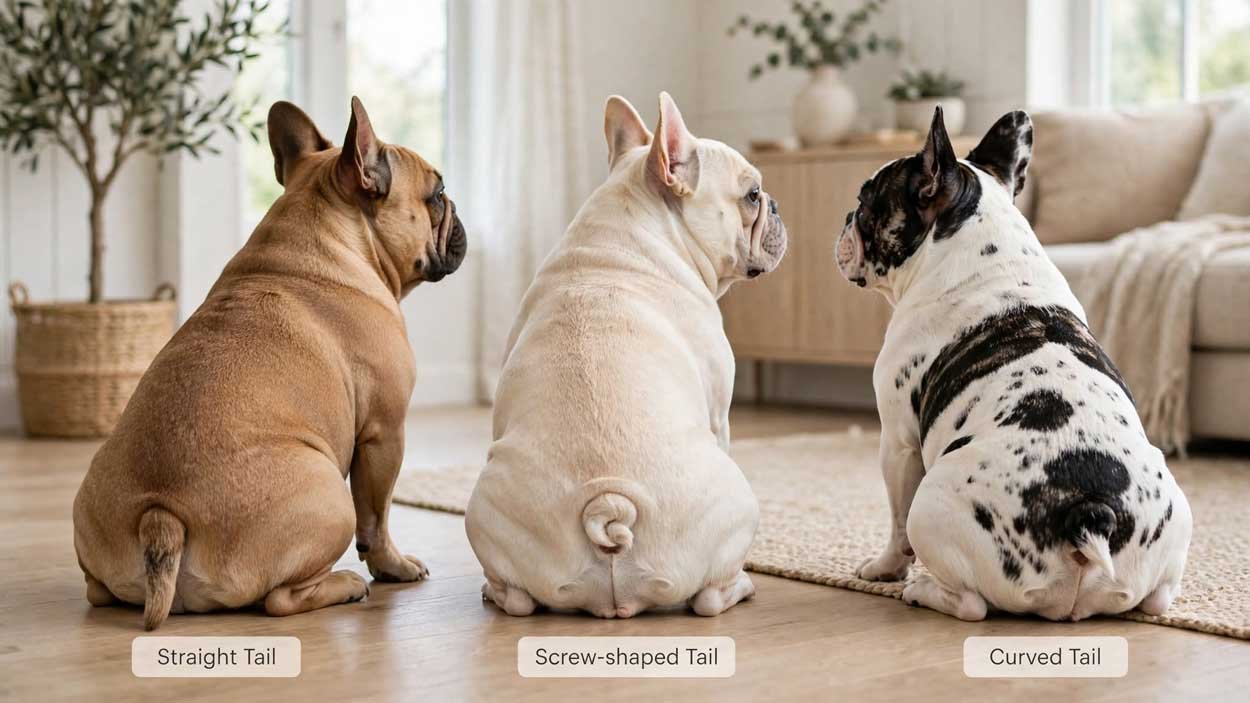
French Bulldog tails come in slightly different natural shapes. Although most are short, their appearance can vary.
Here are the most common types:
1. Straight Tail
A straight tail is one of the natural tail shapes found in French Bulldogs.
It usually sits low on the dog’s body, has a thicker base and gradually becomes thinner toward the tip.
Some straight tails are extremely short, while others are a little longer.
A naturally straight tail is not automatically a sign that your Frenchie is mixed with another breed.
2. Screw-Shaped Tail
A screw-shaped tail is another recognizable French Bulldog tail type.
It has a twisted or curved appearance caused by the shape and arrangement of the tail vertebrae.
Some screw tails are relatively loose and easy to examine. Others may be tightly curled or positioned close to the body.
The important difference is comfort and function. A tail that is tightly inverted or causes skin irritation deserves veterinary attention.
3. Slightly Curved Tail
Some Frenchies have a small tail that curves gently to one side or downward.
This natural variation can look different from the traditional screw-shaped tail.
What matters most is whether the tail is comfortable, the surrounding skin is healthy and the dog can move without signs of pain.
Do Some French Bulldogs Have Long Tails?
Yes! Some French Bulldogs naturally have longer tails than others.
Although the breed is known for its short tail, individual Frenchies can have noticeable differences in tail length and shape.
A slightly longer natural tail does not automatically mean your French Bulldog is a mixed breed.
The American breed standard describes the French Bulldog’s tail as short, set low and thick at the root, with a tapering tip. It allows natural variation in tail shape.
If you are purchasing a purebred French Bulldog, you should look at the dog’s overall characteristics, pedigree and health records rather than judging its breed purity based on tail length alone.
Remember: A longer natural tail is not proof that a Frenchie is mixed, and a very short tail is not proof of better breed quality.
Are French Bulldogs Born Without Tails?
A French Bulldog may appear almost tailless because its natural tail is extremely short.
However, there is a difference between having a naturally short tail and having no tail at all.
Some dogs can have congenital tail abnormalities, meaning their tails develop differently before birth.
A completely absent tail is not something you should automatically assume is normal for a French Bulldog.
If your puppy appears to have no tail, or you notice an unusual opening, swelling, discomfort or skin problems around the tail area, ask your veterinarian to examine it.
A veterinary examination can help determine whether the tail structure is normal or whether an underlying problem needs attention.
Are French Bulldog Tails Docked?
Many people assume that French Bulldogs have short tails because breeders cut them shortly after birth.
However, this is not generally the case.
French Bulldogs are naturally short-tailed dogs. Their characteristic tail shape is inherited, and routine tail docking is not necessary to achieve the typical appearance of the breed.
Tail docking is a surgical procedure in which part or all of a dog’s tail is removed.
Although cosmetic tail docking has been practiced in different dog breeds, it is not a necessary procedure for a healthy French Bulldog.
The American Animal Hospital Association (AAHA) opposes tail docking for cosmetic or breed-standard purposes.
There is also an important welfare concern: tail docking involves removing living tissue and can cause pain.
If a French Bulldog has a genuine medical problem involving its tail, a veterinarian may recommend surgery when appropriate. That is different from removing a healthy tail for appearance.
Why Do Some French Bulldogs Have Their Tails Removed?
There are two different situations to understand.
1. Cosmetic tail docking
Cosmetic docking means removing part of a dog’s tail simply to change its appearance.
This is not medically necessary for a healthy French Bulldog.
2. Medically necessary tail surgery
Sometimes, a French Bulldog may develop a serious problem involving its tail.
For example:
- Repeated infections that do not respond adequately to treatment.
- Severe skin inflammation around a tightly inverted tail.
- Painful or damaged tail tissue.
- Persistent wounds or other structural problems.
In certain cases, a veterinarian may recommend surgical treatment, including partial tail removal.
The decision should always be based on the dog’s individual health, examination findings and treatment options.
Can French Bulldogs Have Tail Pocket Problems?
Yes. Some French Bulldogs develop a condition commonly known as tail pocket dermatitis.
A tail pocket is a small skin fold or indentation around the base of the tail. Because of the shape of some French Bulldog tails, the surrounding skin can trap moisture, dirt and debris.
When this area is not kept clean and dry, irritation and bacterial or yeast overgrowth may develop.
However, not every French Bulldog has a tail pocket. Some have a more open tail area and need much less maintenance.
Signs of a French Bulldog Tail Pocket Infection
As a Frenchie owner, watch for these common warning signs:
- Red or irritated skin around the tail.
- An unpleasant or unusual smell.
- Excessive licking or chewing near the tail.
- Moisture or discharge inside the skin fold.
- Swelling or sensitivity when touched.
- Scooting or showing signs of discomfort.
If you notice these symptoms, do not assume that ordinary cleaning will solve the problem.
A veterinarian should examine the area to determine whether your Frenchie has skin-fold inflammation, an infection or another condition.
How to Clean a French Bulldog Tail Pocket
If your Frenchie has a tail pocket, gentle and regular cleaning can help keep the area comfortable.
Follow these basic steps:
Step 1: Check the area
Gently lift the tail if your dog allows it. Look for trapped dirt, moisture, redness or an unusual smell.
Step 2: Use a soft, clean cloth
Use a soft cloth or a suitable pet-safe cleaning product recommended by your veterinarian.
Avoid harsh soaps, alcohol, hydrogen peroxide and strongly scented products.
Step 3: Clean gently
Carefully remove visible dirt from the accessible skin fold. Never force your fingers or cleaning materials into a tight or painful area.
Step 4: Dry the area completely
This is one of the most important steps.
Use a clean, soft towel to gently dry the area. Leaving moisture trapped in a skin fold can encourage further irritation.
Step 5: Monitor your Frenchie
Check the skin regularly. If redness, odor, discharge or discomfort continues, contact your veterinarian instead of repeatedly cleaning an inflamed area.
A dog with frequent tail pocket infections may need a more specific veterinary treatment plan.
Keep Your Frenchie’s Tail Pocket Clean
Looking for an easy way to keep your Frenchie’s skin folds clean? Dog-specific wrinkle wipes can help remove everyday dirt and debris from accessible skin folds.
Recommended: Petazy Wrinkle Wipes
Can French Bulldogs Have Curly Tails?
Yes, some French Bulldogs have naturally curved or screw-shaped tails.
However, there is a difference between a gently curved tail and a tightly twisted or inverted tail.
The shape of a Frenchie’s tail depends partly on how its tail vertebrae develop.
A mildly curved tail may not cause any noticeable problems, but a tight screw-shaped tail can create skin folds that are difficult to keep clean.
It may also be associated with abnormal vertebral development.
If your Frenchie has a very tightly curled tail, recurring irritation or discomfort, ask your veterinarian whether an examination is needed.
Do not try to straighten or manipulate your dog’s tail yourself.
Does a French Bulldog’s Tail Affect Its Health?
It can, depending on the structure of the tail.
A naturally short tail does not automatically mean your Frenchie has a health problem.
However, certain tail and spinal abnormalities deserve attention.
For example, some French Bulldogs can develop hemivertebrae. These are abnormally shaped vertebrae that may affect the spine.
Depending on their location and severity, spinal abnormalities can sometimes put pressure on the spinal cord.
Watch for warning signs such as:
- Weakness in the back legs.
- Difficulty walking or standing.
- An unusual walking pattern.
- Back pain or sensitivity.
- Loss of coordination.
- Changes in bladder or bowel control.
These symptoms are not something to dismiss as normal French Bulldog behavior.
If your dog suddenly develops weakness, difficulty walking or loss of bladder or bowel control, seek veterinary care promptly.
A veterinarian may recommend a neurological examination or diagnostic imaging depending on the symptoms.
Are French Bulldogs’ Tails Docked in the USA?
In the United States, tail docking laws and regulations vary by state and locality.
There is no single nationwide rule that makes every cosmetic tail docking procedure illegal in all circumstances.
However, the American Animal Hospital Association opposes cosmetic tail docking and recommends that veterinarians avoid performing elective procedures that are not medically necessary.
If you are purchasing a French Bulldog puppy, ask the breeder whether the tail is completely natural or whether any surgical procedure has been performed.
You can also ask for veterinary records and have your puppy examined by an independent veterinarian.
If you are considering any tail-related procedure, discuss the medical reasons, risks and alternatives with a licensed veterinarian.
Can Purebred French Bulldogs Have Long Tails?
Absolutely!
A purebred French Bulldog can naturally have a tail that is more noticeable or longer than the tails of other Frenchies.
Tail length alone does not determine whether a dog is purebred.
If you want to verify a French Bulldog’s breed background, consider:
- Pedigree documentation.
- Registration records from a recognized kennel organization.
- Information about the parents.
- A reputable breeder’s records.
- A veterinarian’s overall health assessment.
A responsible breeder should be willing to discuss the puppy’s physical characteristics and health history.
Most importantly, do not choose a French Bulldog simply because its tail is shorter or more tightly curled. Health, comfort and responsible breeding should always come first.
How to Keep Your French Bulldog’s Tail Healthy
Your Frenchie’s tail may be small, but it still deserves regular attention.
Here are some simple habits that can help:
1. Check the tail regularly
Look for redness, swelling, unusual odors, discharge or trapped debris.
2. Keep the tail area clean and dry
If your Frenchie has a tail pocket, gently clean it using a veterinarian-approved method.
3. Avoid excessive cleaning
Cleaning too aggressively or using harsh products can irritate sensitive skin.
4. Watch for changes in behavior
If your Frenchie suddenly starts licking, biting or rubbing its tail area, investigate the cause.
5. Schedule veterinary checkups
Regular wellness examinations help your veterinarian identify skin and structural problems before they become more serious.
6. Never attempt to remove or straighten the tail yourself
Any concern involving the structure of the tail should be evaluated by a qualified veterinary professional.
A Simple Grooming Essential for Frenchie Owners
Keep a pack of gentle, unscented dog grooming wipes at home for quick everyday cleanups. They can be useful for cleaning your dog’s paws and body between baths.
Explore Unscented Dog Wipes on Amazon →
Frequently Asked Questions About Do Frenchies Have Tails
1. Do Frenchies have tails naturally?
Yes. French Bulldogs are generally born with naturally short tails. Their tails may be straight, slightly curved or screw-shaped.
2. Are French Bulldogs born with short tails?
Yes. Their short tails are a natural breed characteristic influenced by genetics and the development of their tail vertebrae.
3. Why is my French Bulldog’s tail so small?
French Bulldogs have inherited characteristics that result in naturally short tails. Differences in the number, shape and arrangement of tail vertebrae contribute to their appearance.
4. Can a French Bulldog have a long tail?
Yes. Some purebred French Bulldogs naturally have longer tails than others. Tail length alone does not determine whether a Frenchie is purebred.
5. Are French Bulldog tails cut off after birth?
Not necessarily. Frenchies are naturally short-tailed dogs. Cosmetic docking is not needed to give a healthy French Bulldog its characteristic tail.
6. Do all French Bulldogs have tail pockets?
No. Some French Bulldogs have a noticeable tail pocket, while others do not. The amount of skin folding around the tail varies between individual dogs.
7. Why does my French Bulldog’s tail smell bad?
An unpleasant smell may be caused by trapped moisture, dirt, skin-fold inflammation or infection around the tail pocket. Other conditions can also cause similar odors. If the smell persists or comes with redness or discharge, have your veterinarian examine the area.
8. Can a French Bulldog’s tail get infected?
Yes. Skin folds around a tightly positioned tail can trap moisture and debris, potentially leading to irritation and infection.
9. Are screw tails bad for French Bulldogs?
Not every screw-shaped tail causes problems. However, a tightly inverted or abnormal tail can be associated with skin irritation and other structural concerns. A veterinarian should assess tails that are painful, difficult to clean or repeatedly infected.
10. Should I buy a French Bulldog with a longer tail?
A longer natural tail is not automatically a problem. Focus on the puppy’s overall health, breathing, movement, spinal health, temperament and responsible breeding history rather than tail length alone.
Don’t Forget to Dry Your Frenchie’s Tail Area
After cleaning or bathing, gently dry the accessible skin around your dog’s tail using a soft, absorbent microfiber pet towel. Keeping skin folds dry is an important part of everyday grooming.
Find a Dog Microfiber Towel on Amazon →
Final Thoughts: Do Frenchies Have Tails?
Yes, French Bulldogs do have tails! Their naturally short tails are one of the physical features that make this breed so recognizable.
Some Frenchies have straight tails, others have gently curved or screw-shaped tails, and a few naturally have longer tails than others.
Although their short tails are generally a normal breed characteristic, certain structural abnormalities can contribute to skin irritation, tail pocket infections and spinal problems.
As a responsible Frenchie owner, pay attention to your dog’s tail area, keep any skin folds clean and dry, and contact your veterinarian if you notice persistent odor, redness, swelling or discomfort.
Remember, a healthy Frenchie is much more important than having a perfectly short or perfectly shaped tail. Your dog’s comfort, mobility and overall well-being should always come first.
Affiliate Disclosure: As an Amazon Associate, FrenchieTails earns from qualifying purchases.