
French Bulldog Home Safety Checklist: How Safe Is Your Home for Your Frenchie?
Your home may feel completely safe to you, but your French Bulldog sees it differently.
A loose phone charger can become something to chew. An open trash can can turn into an afternoon snack hunt. A small object left on the floor may suddenly become very interesting.
Frenchies are curious, determined, and often surprisingly good at finding things we thought were out of reach.
That is why a quick French Bulldog home safety check can be worth doing regularly.
To make it easier, we created a free French Bulldog Home Safety Check that walks you through the most important areas of your home, gives you a personalized safety score, and shows you which areas deserve the most attention.
You can also print or save your completed report as a PDF so you can keep it for future reference.
Why Is Home Safety Important for French Bulldogs?
French Bulldogs are indoor companion dogs, which means they spend a lot of time around the same household environment as their families.
That makes everyday home safety important.
Some risks are obvious, such as household chemicals or an unsecured balcony. Others are easy to overlook because they are normal parts of everyday life.
Think about:
- Phone chargers and electrical cords
- Cleaning products
- Small household objects
- Food left on counters
- Open trash cans
- Indoor and outdoor plants
- Doors and gates
- Balconies and railings
- Hot weather
- Stairs and elevated areas
- Collars, harnesses, and identification
You do not need to make your home feel like a laboratory. The goal is simply to identify the areas where your Frenchie could get into trouble and make sensible changes.
French Bulldog Home Safety Checklist
Here are some of the main areas worth checking around your home.
-
Secure Electrical Cords and Chargers
Frenchies can be curious about anything lying around the house.
Keep electrical cords, charging cables, power strips, and similar items organized and out of easy chewing range.
This is especially important for puppies, but adult dogs can also develop a sudden interest in something they previously ignored.
A simple rule is:
If your Frenchie can easily reach it and chew it, ask yourself whether it really needs to be there.
-
Keep Household Chemicals Secure
Cleaning products, detergents, and other household chemicals should be stored where your dog cannot access them.
Do not rely only on a bottle being placed on a countertop. Consider cabinets, closed storage, or another location that your Frenchie cannot reach.
Remember to check areas such as:
- Kitchen cabinets
- Bathroom storage
- Laundry areas
- Garage or utility spaces
- Floor-level cleaning supplies
-
Watch Out for Small Objects
Small objects can be surprisingly tempting to dogs.
Take a quick look around the floor and other areas your Frenchie can access.
Pay attention to things such as children’s toys, small household items, loose pieces, packaging, and anything that could become a chewing or swallowing hazard.
This is particularly important if you have a Frenchie puppy who is exploring everything with their mouth.
-
Check Doors, Gates, and Escape Routes
A safe home is also a home that your dog cannot easily escape from.
Check your:
- Front door
- Back door
- Baby gates
- Yard gates
- Balcony doors
- Fences
- Railings
- Other possible escape points
Do not forget to look for small gaps or areas that may become accessible when a door or gate is opened.
Food Safety Around the House
The kitchen is one of the places where everyday habits can make a big difference.
Keep Human Food Out of Reach
Dogs may be interested in foods that are perfectly normal for people but may not be appropriate for them.
Keep food, leftovers, and food scraps managed rather than assuming your Frenchie will ignore them.
Counters and dining tables can also be worth checking, especially if your dog has learned that jumping up can lead to interesting discoveries.
Make the Trash Can Difficult to Access
An open or easily accessible trash can can become an irresistible target.
Food wrappers, leftovers, bones, packaging, and other discarded items may create unnecessary risks.
If your Frenchie is a determined trash explorer, consider using a more secure trash can or placing it somewhere your dog cannot reach.
Check Your Plants
Plants are another area that is easy to overlook.
If your Frenchie has access to indoor plants, outdoor plants, a yard, or a balcony, identify the plants and check whether they are considered safe for dogs.
If you are unsure about a particular plant, keep your dog away from it until you can verify its safety through a reliable source or your veterinarian.
This is especially useful when bringing a new plant into your home.
Make Outdoor Areas Secure
If you have a yard, balcony, patio, or other outdoor space, take a few minutes to inspect it from your dog’s perspective.
Look for:
- Gaps under or between fences
- Loose gates
- Low railings
- Damaged fencing
- Open balcony doors
- Objects that could help your dog climb
- Areas where your dog could become trapped
Walk around the area rather than checking it from inside the house.
You may notice something different when you look at it from your Frenchie’s level.
Pay Special Attention to Hot Weather
Temperature management deserves special attention for French Bulldogs.
Frenchies are a flat-faced breed and can have difficulty coping with heat. A comfortable indoor environment, access to a cool resting area, and sensible planning during hot weather are important parts of responsible care.
During warm weather, think about where your Frenchie rests during the hottest part of the day and whether that area stays comfortable.
Avoid assuming that your dog will always know when they have had enough activity in hot conditions.
If your Frenchie shows signs of heat-related distress, seek veterinary help promptly.
Give Your Frenchie a Safe Resting Area
Every dog benefits from having a comfortable place to relax.
Your Frenchie’s resting area should be somewhere they can settle without being constantly disturbed by household traffic.
This can be especially helpful in busy homes with children, visitors, or other pets.
A quiet resting area also gives your dog a predictable place to go when they want some downtime.
Think About Stairs and Elevated Areas
Not every home presents the same mobility challenges.
Look at your stairs, furniture, balconies, beds, couches, and other elevated areas based on your individual Frenchie’s age and mobility.
A young dog, an adult dog, and a senior Frenchie may have very different needs.
Instead of assuming an area is safe because your dog has used it before, regularly reassess it as your Frenchie grows older.
Check Your Frenchie’s Identification
Home safety is not only about preventing accidents inside the house.
It is also about being prepared if your Frenchie ever gets out unexpectedly.
Make sure identification information is current and check your dog’s collar or harness regularly for fit and condition.
If your contact information has changed, update your dog’s identification information as soon as possible.
How Safe Is Your Home for Your Frenchie?
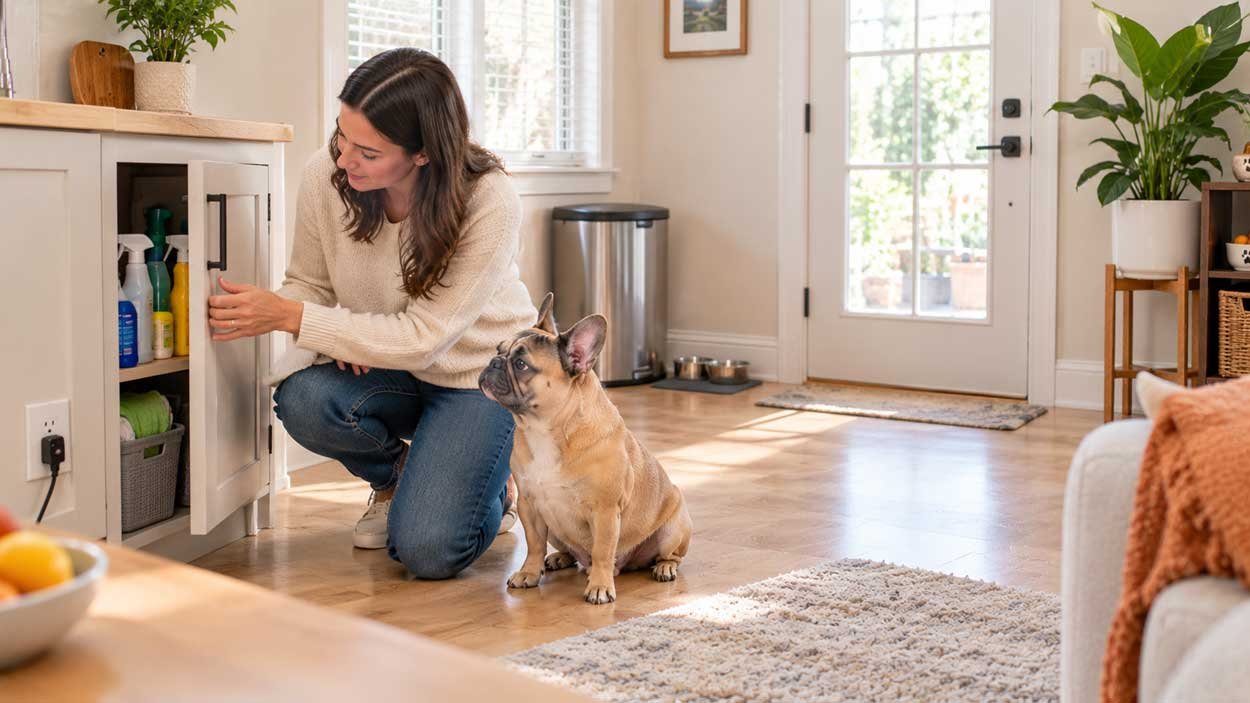
It can be difficult to remember every safety area when you are simply walking around your home.
That is why we created the French Bulldog Home Safety Check.
The free calculator takes you through a complete checklist covering 13 everyday safety areas.
You simply answer the questions about your home and your Frenchie.
The tool then gives you:
- A personalized home safety score
- A simple safety status
- Your priority areas
- Recommendations based on the answers you marked as not yet covered
- A summary of the safety areas you have already covered
- The option to print or save your report as a PDF
- A share option for your report
Use the Free French Bulldog Home Safety Check
Instead of trying to remember everything yourself, take a few minutes to go through the complete checklist.
French Bulldog Home Safety Calculator
Once you finish, you can print or save the report as a PDF and use it as a simple reference when you review your home again.
A Good Time to Repeat Your Safety Check
Home safety is not something you only need to think about once.
Your Frenchie’s needs can change over time.
You may also move to a new home, add furniture, bring home a new plant, get a puppy, change your outdoor space, or have a new baby or pet.
Those changes can create new safety considerations.
A quick review every few months can help you notice things that have become easy to overlook.
Frenchie Home Safety: Start With the Biggest Risks
You do not have to change your entire home in one afternoon.
Start with the areas that could create the biggest problem if your Frenchie accessed them.
Secure the chemicals.
Manage the electrical cords.
Check the escape routes.
Control food and trash access.
Review plants.
Make sure outdoor areas are secure.
Then look at comfort, resting areas, stairs, and everyday equipment.
Small changes can make your home more manageable and give you greater peace of mind.
Final Thoughts
A Frenchie-friendly home does not have to be perfect.
It simply needs to be thoughtfully managed.
The best approach is to regularly look at your home from your dog’s point of view and ask a simple question:
“Could my Frenchie get into trouble here?“
If the answer is yes, make the area safer where you can.
And when you want a quick way to review the major areas, use our French Bulldog Home Safety Check. It gives you a complete 13-point checklist, a personalized score, priority recommendations, and a printable/saveable report you can keep for later.
Your Frenchie does not need a perfect home. They need a home that has been prepared with them in mind. 🐾
Important Note
This home safety checklist is provided for general educational and informational purposes. It is not a substitute for veterinary, medical, emergency, or other professional advice. Every French Bulldog is different, and individual safety needs may vary based on age, health, mobility, behavior, and environment. If you are concerned about your Frenchie’s health or safety, contact your veterinarian or another appropriate qualified professional.